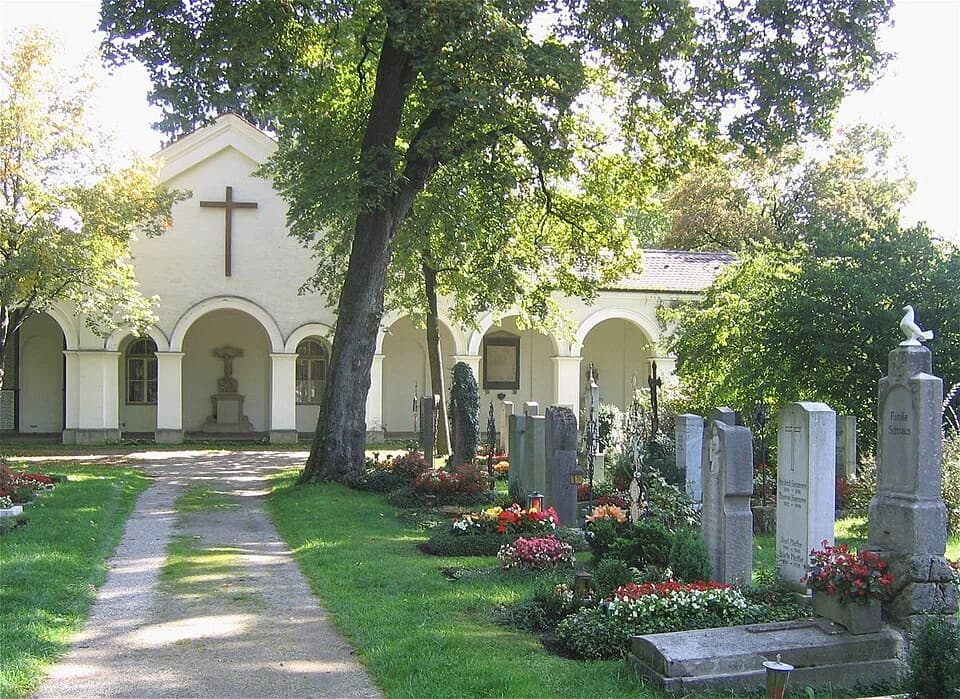
Nymphenburger Friedhof
Maria-Ward-Straße 5, München
Austrian actor and film director
0 Entries
Be the first to share a memory.
Bernhard Wicki (born 28 October 1919 in St. Pölten; died 5 January 2000 in Munich) was an Austrian-Swiss actor, film director, screenwriter and photographer. In German-language cinema his name remains especially connected with Die Brücke, one of the defining anti-war films of the postwar period.
Wicki was born in Lower Austria; his father came from Switzerland and his mother from Austria-Hungary. He first studied art history, history and German literature, then moved into acting. In 1939 he was imprisoned for several months in Sachsenhausen concentration camp because of his connection with the Bündische Jugend. After his release he continued his training and theatre work in Vienna and later in Switzerland.
After the Second World War Wicki worked on German-language stages and entered film in the early 1950s. Helmut Käutner's Die letzte Brücke brought him to a wider cinema audience. Georg Wilhelm Pabst cast him as Claus Schenk Graf von Stauffenberg in Es geschah am 20. Juli. Later Wicki also acted for Michelangelo Antonioni, Rainer Werner Fassbinder, Andrzej Wajda and Wim Wenders.
In 1959 Wicki directed Die Brücke. The film tells of teenagers ordered to defend a militarily meaningless bridge in the last days of the war. Wicki staged the material without a triumphant gesture: the young characters appear as victims of ideological seduction and of a war that is already lost. The film received international awards and was nominated for the Academy Award for best foreign-language film.
After Die Brücke, Wicki made Das Wunder des Malachias, directed the German sections of The Longest Day and worked on international productions such as The Visit with Ingrid Bergman and Anthony Quinn and Morituri with Marlon Brando and Yul Brynner. His films often searched for moral pressure, for images of violence, responsibility and the consequences of political delusion.
Wicki remained active as an actor and director into the 1990s. He photographed, worked for cinema and television and was regarded in Germany as an idiosyncratic, uncompromising film voice. After his death, the Bernhard Wicki Memorial Fund was created; its film prize Die Brücke has since honored works connected with peace, humanity and political responsibility.
Bernhard Wicki died in Munich on 5 January 2000. He was 80 years old and was buried at the Nymphenburg cemetery. The memory of him centers on an attitude: film does not soften violence, but makes responsibility visible and takes viewers seriously.
Bernhard Wolfgang Wicki wird in St. Pölten in Niederösterreich geboren.
Wickis Antikriegsfilm Die Brücke startet in den Kinos der Bundesrepublik.
Die Brücke ist bei den 32. Academy Awards als bester fremdsprachiger Film nominiert.
Bernhard Wicki stirbt im Alter von 80 Jahren in München.
No obituary has been uploaded for this memorial page yet. If you are one of the loved ones and would like to upload one, you can register as the owner of this memorial page and add it afterward.
Maria-Ward-Straße 5, München
Bernhard Wicki. Forever remembered.