

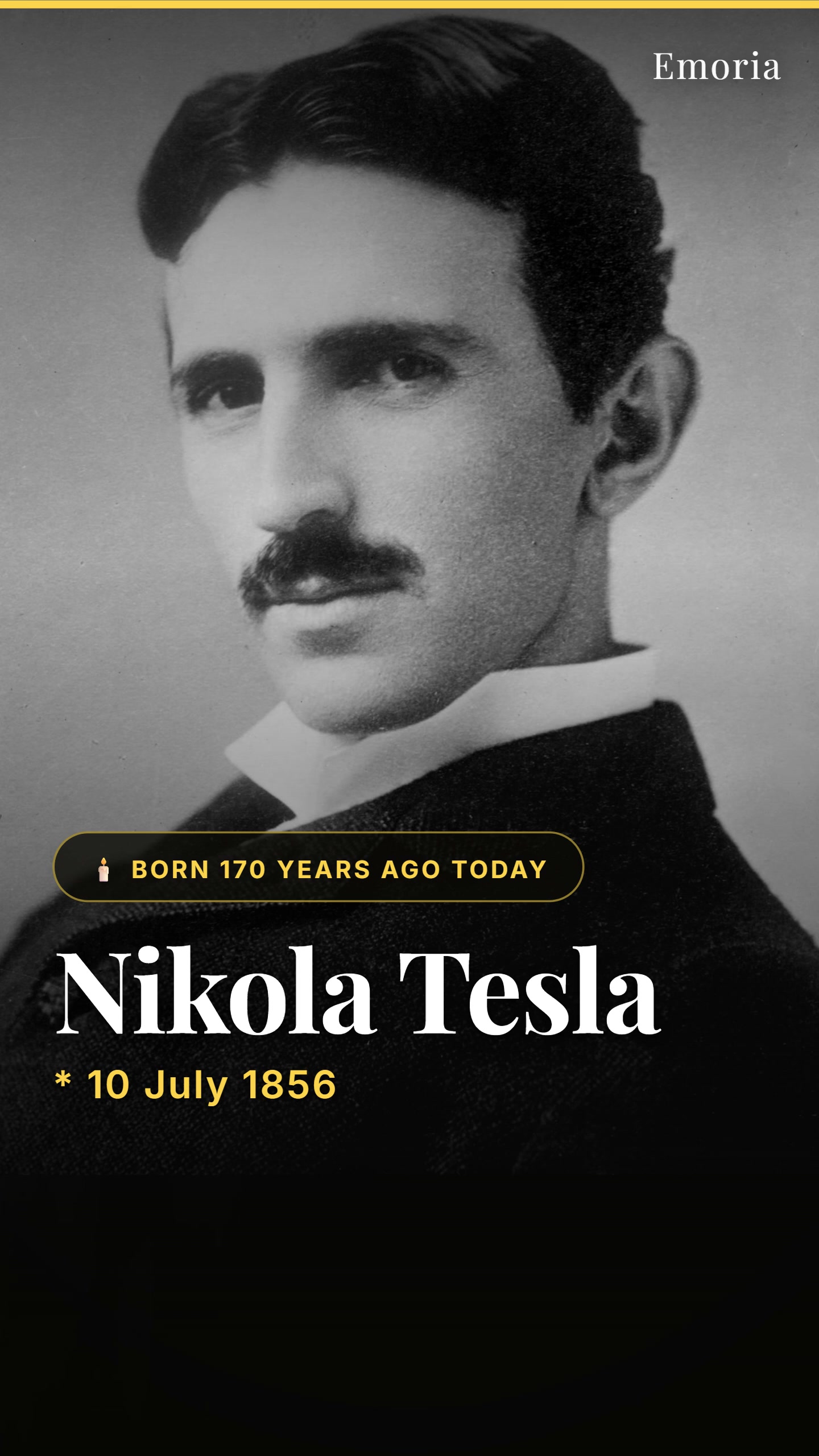
Memorial Page for Nikola Tesla
Serbian-American engineer and inventor
Memorial Candles
2 candles

Emoria lights a memorial candle for Nikola Tesla's birthday.
Emoria
July 10th, 2026
“Happy Birthday dear Nikola! You are a legend.”
Michael J.
July 10th, 2026
Condolence Book
0 Entries
Memories
42 memories
🎂 Birthday

Kroatien (HR) - Gespanschaft Istrien (036) - Poreč: Hausnummer "2" in der "Ulica Nikole Tesla"

Tesla Street located in Shoreham, Long Island, NY where Nikola Tesla's lab/museum is located.

High Frequency Alternator

Tesla coil oscillator

The street sign of the “Ulica Nikole Tesle” (Nikola Tesla street) in Zagreb (Croatia)

RMFpatent

Passport of Nikola Tesla, page 1, 1883.

Tesla lab coil1

TeslaTurbineOriginal

Tesla Egg of Columbus at 1893 World Fair Chicago ELECTRICAL EXPERIMENTER March 1 1919

Nikola Tesla's Egg of Columbus at 1893 Chicago Columbian Exposition World's Fair

Nikola Tesla Statue in Niagara Falls, Ontario, Canada
Biography
Nikola Tesla (born 10 July 1856 in Smiljan; died 7 January 1943 in New York City) was an inventor, electrical engineer and one of the defining figures of the electrical modern age. His work on the alternating-current system, rotating magnetic fields, motors, transformers and high-frequency experiments influenced how electrical energy is generated, transmitted and used. Tesla was later surrounded by legend; for that reason his life deserves precise remembrance: great in its documented achievements, ambitious in its visions and not free from failure.
Origins and education
Tesla was born in Smiljan, then part of the Austrian Empire. His family was Serbian Orthodox; his father Milutin Tesla was a priest, and his mother Georgina is often described as having strong practical inventive ability. Tesla attended schools in the region and later studied technical subjects in Graz. He did not follow a conventional academic path to completion, but gained practical experience in telephony, electrical engineering and machinery. The combination of theoretical imagination and technical practice became decisive for his later life.

From Europe to New York
After several European stations, Tesla arrived in New York on 6 June 1884. He initially worked in the orbit of Thomas Edison, but soon moved away from that path. Tesla searched for solutions to electrical systems that could transmit power efficiently over longer distances. The central idea was alternating current. Direct-current systems mattered in early electrification, but alternating current opened different possibilities for voltage, transformation and long-distance transmission.
The rotating magnetic field
Tesla's most important technical achievement was the development of systems based on the rotating magnetic field and polyphase alternating current. On 16 May 1888, he presented a new system of alternating-current motors and transformers before the American Institute of Electrical Engineers. That same year, George Westinghouse became interested in Tesla's patents and acquired rights to his system. Tesla thus became part of a larger industrial process: not a single brilliant idea alone, but invention, patents, engineers, capital and infrastructure together made alternating current practically effective.

Alternating current, Westinghouse and Niagara
The collaboration with Westinghouse made Tesla's alternating-current system publicly visible. The 1893 World's Columbian Exposition in Chicago showed a broad audience that alternating current could serve lighting, motors and industrial use. An even stronger signal came from the Niagara project. On 16 November 1896, electrical power from Niagara Falls reached Buffalo. That event marks the movement from experiment and demonstration to large-scale power supply. Tesla was not the only actor, but his patents and ideas were an important part of the system.
High frequency, light and the Tesla coil
On 20 May 1891, Tesla demonstrated experiments with high-frequency alternating currents and electric lighting in New York. In that context the Tesla coil emerged, a transformer for very high voltages and high frequencies. Tesla produced spectacular effects, but behind the spectacle was serious research into electrical oscillations, resonance, light and wireless transmission. These works made him famous as a lecturer and experimenter, while also showing how closely his thinking was tied to concrete apparatus.

Colorado Springs and wireless visions
In 1899 Tesla went to Colorado Springs to experiment with very high voltages and wireless transmission. There he worked with large coils, electrical discharges and measurements that later fed into his vision of a worldwide wireless system. The famous image in which Tesla sits calmly beside enormous electrical discharges is one of the best-known pictures of his life. It is not a simple snapshot of a running experiment, but a double exposure. That distinction matters: Tesla was a brilliant experimenter, but he also understood the power of public images.

Wardenclyffe and the failure of a large idea
From 1901, Tesla worked on the Wardenclyffe project on Long Island. The facility was intended to enable wireless communication and, in Tesla's broader vision, to test large-scale wireless power transmission. The project remained unfinished. Funding, technical reach, competition from other radio developments and Tesla's own expansion of the project's goals made Wardenclyffe fail. Wardenclyffe shows both Tesla's strength and his limit: he thought larger than many of his contemporaries, but not every vision became technically or economically viable.
Later years in New York
In his later years Tesla continued to live in New York. He remained in contact with the public, gave interviews, developed further ideas and received visible attention on his 75th birthday in 1931, including a Time Magazine cover. At the same time, his reputation drifted away from the stable industrial recognition attached to his earlier alternating-current work. Some of his later announcements remained speculative or unrealised. That does not reduce his documented achievements, but it shows the distance between the historical Tesla and the later myth.

Death and legacy
Nikola Tesla died on 7 January 1943 at the Hotel New Yorker. His legacy does not lie in presenting him as a solitary wizard of electricity. It lies in concrete technical contributions: alternating-current motors, polyphase systems, high-frequency experiments, resonance and ideas for wireless communication. Tesla was an inventor of exceptional imagination, but also a person whose projects depended on money, patents, competition and public attention. That sober view makes his significance larger, not smaller.
Life Events
7 EventsGeboren in Smiljan
1856Nikola Tesla wird in Smiljan im damaligen Kaisertum Österreich geboren, heute in Kroatien.
Ankunft in New York
1884Tesla kommt in New York an und beginnt sein amerikanisches Leben als Ingenieur.
Vortrag über Wechselstrommotoren
1888Vor dem American Institute of Electrical Engineers stellt Tesla sein System von Wechselstrommotoren und Transformatoren vor.
Öffentliche Tesla-Spulen-Demonstration
1891In New York demonstriert Tesla Experimente mit hochfrequenten Wechselströmen und elektrischer Beleuchtung.
Niagara-Strom erreicht Buffalo
1896Elektrische Energie aus dem Niagara-Projekt wird nach Buffalo übertragen und macht die Stärke des Wechselstromsystems sichtbar.
Forschung in Colorado Springs
1899Tesla geht nach Colorado Springs, um Hochspannungs- und drahtlose Übertragungsexperimente durchzuführen.
Gestorben in New York
1943Nikola Tesla stirbt im Alter von 86 Jahren im Hotel New Yorker.
Obituary
No obituary yet
No obituary has been uploaded for this memorial page yet. If you are one of the loved ones and would like to upload one, you can register as the owner of this memorial page and add it afterward.
Family Tree
- Milutin Tesla
- Đuka Tesla
- Marica Kosanovic
Nikola Tesla. Forever remembered.