Auvers-Sur-Oise Communal Cemetery
Auvers-sur-Oise

Dutch painter
2 candles
Emoria lights a memorial candle in remembrance of Vincent van Gogh.
Emoria
July 29th, 2026
Emoria lights a memorial candle for Vincent van Gogh's birthday.
Emoria
March 30th, 2026
0 Entries
44 memories
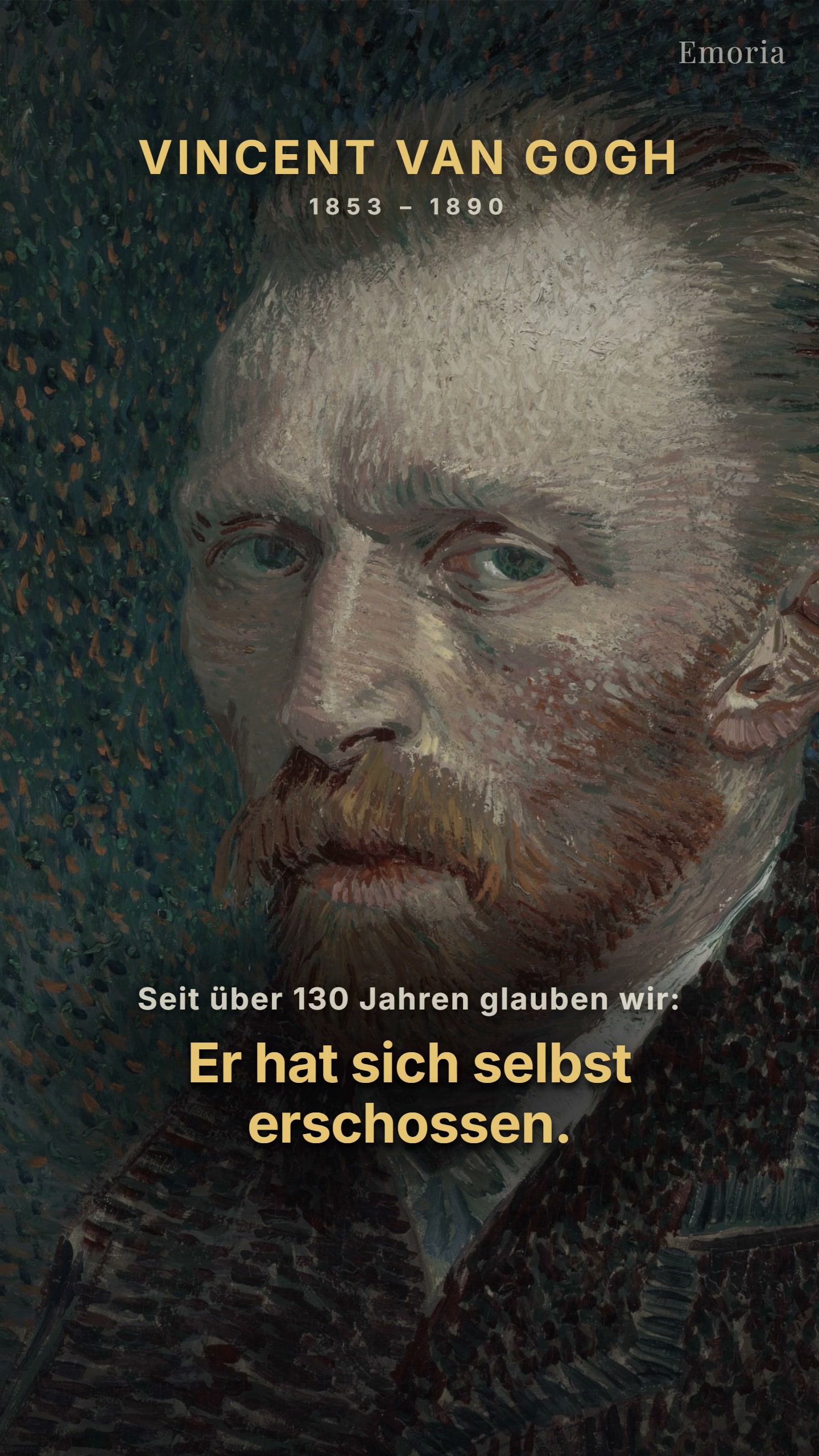
🕯️ Anniversary of death

An Old Man Putting Dry Rice on the Hearth 1881 Vincent van Gogh

Vincent Van Gogh 0017

Van Gogh Irises in NYC partial

Vincent van Gogh - Field with Poppies (1889)

Vincent van Gogh: Irises (1890).

VanGogh-Irises 1

VanGogh-View of Arles with Irises

Vincent van Gogh - Dr Paul Gachet - Google Art Project

Vincent van Gogh - Portrait of Joseph Roulin - Google Art Project

Van Gogh - Blumentopf mit Aschenkraut

Van Gogh - Vase mit Nelken1

Self-portrait
Vincent van Gogh (born 30 March 1853 in Zundert; died 29 July 1890 in Auvers-sur-Oise) was a Dutch painter and draftsman. He is one of the defining figures of modern art. In little more than ten years, Van Gogh created a body of work that runs from dark Dutch interiors to the bright colors of southern France. His paintings show fields, people, rooms, flowers and faces not as smooth reality, but as tense, visible experience.

Van Gogh was born the son of a Dutch Reformed minister. As a young man he worked for the art dealers Goupil & Cie, and later as a teacher, bookseller's assistant and lay preacher. For years he found no stable professional direction. His time in the Borinage, a poor mining region in Belgium, especially shaped his view of labor, poverty and religious seriousness. Around 1880 he chose art. The decision came late, but not out of nowhere: he had already read intensely, drawn, observed and corresponded with his brother Theo about art and life.
In the Netherlands, Van Gogh first concentrated on drawing, figure studies and scenes from rural life. The colors of his early paintings are often earthy and dark. The Potato Eaters of 1885 does not show an idyllic peasant world, but tired bodies, hard work and a shared meal in sparse light. Van Gogh was searching for truthfulness in this phase: hands, faces, clothes and rooms were not meant to look elegant, but believable. That explains why his early works look so different from the later paintings made in Paris and southern France.
In 1886 Van Gogh moved in with Theo in Paris. There he saw works by the Impressionists and Neo-Impressionists, met artists such as Henri de Toulouse-Lautrec, Émile Bernard and Paul Gauguin, and studied Japanese color woodcuts. His palette became brighter, his brushwork freer, and color became a more independent expressive tool. The many self-portraits of these years were not only self-examination, but also practice: when models were unavailable or money was short, his own face became a working surface.
In February 1888 Van Gogh went to Arles. In the south of France he searched for light, clear color and the possibility of an artists' house. In a short time he painted orchards, cafés, fields, bridges, rooms, friends and flowers. The Sunflowers are among the best-known works from this phase. They are not merely decorative, but show how Van Gogh found his own intensity through yellow, flatness, repetition and visible brushwork. At the same time, Arles was not an uncomplicated success story. His collaboration with Paul Gauguin failed, and at the end of 1888 Van Gogh suffered a severe crisis.

Van Gogh's illness has never been conclusively diagnosed. What is certain is that he suffered recurring severe crises and needed medical care after the incident in Arles. A careful account of his life should not reduce this period to the legend of the suffering genius. Van Gogh did not work because illness automatically produced art, but despite uncertainty, fear and breakdowns. In 1889 he admitted himself to Saint-Paul-de-Mausole near Saint-Rémy. There he continued to paint and draw: cypresses, olive groves, gardens, fields, clinic rooms and flowers.

In May 1890 Van Gogh moved to Auvers-sur-Oise, closer to Theo and under the care of Dr. Paul Gachet. In only a few weeks he painted an astonishing number of works: houses, roads, gardens, fields and portraits. On 27 July 1890 he was found badly wounded; two days later he died in Auvers-sur-Oise. He was 37 years old. During his lifetime he sold little, but after his death Theo, Jo van Gogh-Bonger and later the family preserved much of the work and the letters. They made visible how consistently Van Gogh had worked: not as a mere myth, but as an artist who connected color, line and feeling in a new way.
Vincent Willem van Gogh wird in Zundert in den Niederlanden geboren.
Van Gogh beginnt eine Ausbildung beim Kunsthandel Goupil & Cie, wo er erstmals beruflich mit Kunst in Berührung kommt.
Nach Stationen im Kunsthandel, als Lehrer und religiöser Helfer ringt Van Gogh mehrere Jahre um seinen Weg.
Van Gogh beschließt, Künstler zu werden, und beginnt ernsthaft zu zeichnen und zu malen.
In Nuenen malt Van Gogh Die Kartoffelesser, eines der wichtigsten Werke seiner niederländischen Phase.
Van Gogh zieht zu seinem Bruder Theo nach Paris und begegnet Impressionismus, Pointillismus und japanischen Farbholzschnitten.
Van Gogh geht nach Arles, sucht Licht, Farbe und ein gemeinsames Künstlerhaus im Süden Frankreichs.
Nach Spannungen mit Paul Gauguin und einer schweren psychischen Krise verletzt sich Van Gogh am Ohr und wird medizinisch behandelt.
Van Gogh lässt sich in der Klinik Saint-Paul-de-Mausole bei Saint-Rémy behandeln und arbeitet dort weiter intensiv.
Van Gogh zieht nach Auvers-sur-Oise nahe Paris und malt dort in kurzer Zeit eine große Zahl von Bildern.
Vincent van Gogh stirbt im Alter von 37 Jahren in Auvers-sur-Oise.
No obituary has been uploaded for this memorial page yet. If you are one of the loved ones and would like to upload one, you can register as the owner of this memorial page and add it afterward.
Auvers-sur-Oise
Vincent van Gogh (née Vincent Willem Van Gogh). Forever remembered.