
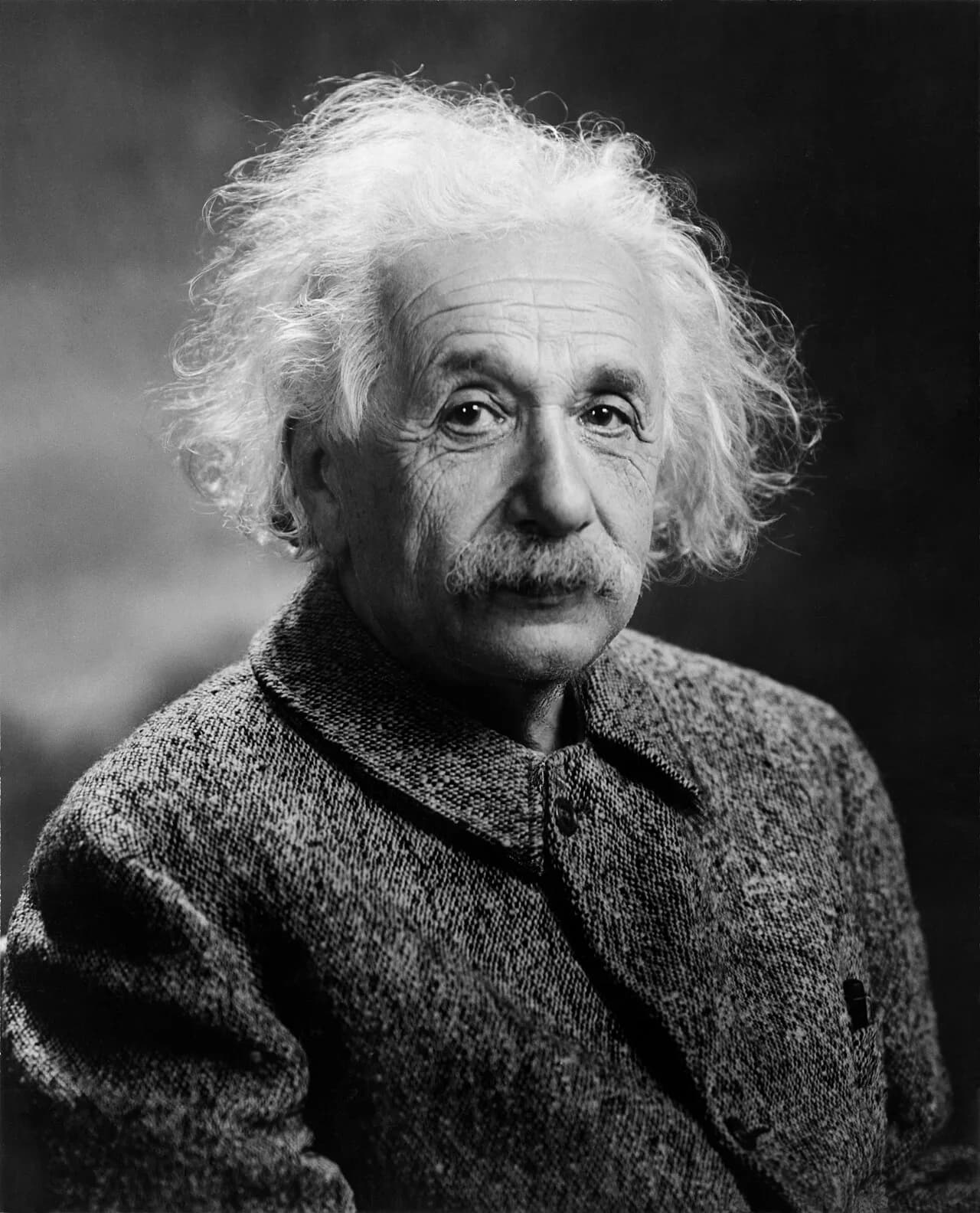
Memorial Page for Albert Einstein
German-born theoretical physicist
Memorial Candles
2 candles

Emoria lights a memorial candle in remembrance of Albert Einstein.
Emoria
April 18th, 2026
Emoria lights a memorial candle for Albert Einstein's birthday.
Emoria
March 14th, 2026
Condolence Book
0 Entries
Memories
44 memories

Albert Einstein writing on a blackboard in Pasadena (1931)

I did not say half of the shit you see on internet - Albert Einstein

Commemorative plaque for Albert Einstein at the home of his parents in Bad Buchau, Germany.

Archenhold-Sternwarte, 642-748

Memorial plaque, Albert Einstein, Bocksfeldstraße 9, Berlin-Wilhelmstadt, Germany

Memorial plaque, Albert Einstein, Haberlandstraße 8, Berlin-Schöneberg, Germany

Memorial plaque, Albert Einstein, Unter den Linden 6, Berlin-Mitte, Germany

Berlin memorial plaque, Albert Einstein, Ehrenbergstraße 33, Berlin-Dahlem, Germany

Pamětní deska – Albert Einstein. Praha, Staré Město čp. 551, Staroměstské náměstí 17.

Albert Einstein

Solvay conference 1927

Memorial plaque, Albert Einstein, Barbarossaplatz 5, Berlin-Schöneberg, Germany
Biography
Albert Einstein (born 14 March 1879 in Ulm; died 18 April 1955 in Princeton, New Jersey) was one of the most influential physicists of the modern era. His work on special relativity, general relativity, the light quantum hypothesis and statistical physics changed the understanding of space, time, gravity, light and matter. He also became a public figure of the 20th century: a scientist, emigrant, pacifist, politically alert warning voice and a person whose image still stands for curious thinking.
Origins, school and early curiosity
Albert Einstein was born in Ulm and grew up mainly in Munich. His family was Jewish, though not strictly religious. He developed an early interest in mathematics, physics and technical questions. After a restless school career, he continued his education in Switzerland, first in Aarau and later at the Swiss Federal Polytechnic in Zurich. These years mattered because Einstein could work more freely there and met people who would remain important in his life.
Bern and the year 1905
In 1902 Einstein received a position at the Swiss Federal Institute of Intellectual Property in Bern. Work at the patent office gave him a steady income while leaving room for his own research. In Bern he produced his so-called annus mirabilis in 1905. In several papers, Einstein addressed the photoelectric effect, Brownian motion, special relativity and the relation between mass and energy. Within a few years, a young official without a university chair became a physicist whose ideas shifted the foundations of his field.

Special relativity and light quanta
Special relativity reframed the question of time and simultaneity. Einstein showed that measurements of space and time depend on the state of motion and that the speed of light has a special role. In another paper, he explained the photoelectric effect by proposing that light can appear in packets of energy under certain conditions. That paper later became central to his Nobel Prize. Einstein was therefore not only the figure associated with relativity, but also an important pioneer of quantum physics.
Berlin and general relativity
In 1914 Einstein moved to Berlin, where he worked at the Prussian Academy of Sciences. There he completed the general theory of relativity in 1915. It described gravity not as an ordinary force, but as an effect of curved spacetime. The theory was mathematically demanding and initially difficult to grasp. Its impact grew when specific predictions could be tested.
The solar eclipse of 1919
On 29 May 1919, expeditions including one led by Arthur Eddington observed a solar eclipse. Their measurements supported Einstein's prediction that light would be deflected in the gravitational field of the sun. The results made Einstein famous worldwide. A specialist physicist became a public figure reported on by newspapers around the world. The fame was sudden, but it rested on a testable scientific prediction.

Nobel Prize and international recognition
In 1922 Einstein received the Nobel Prize in Physics for the year 1921. The award particularly recognised his explanation of the photoelectric effect. That decision shows the breadth of Einstein's scientific importance: his most famous theory was relativity, but the Nobel Prize referred to work that became central to the development of quantum physics. During the 1920s, Einstein travelled widely, lectured and became one of the most visible scientists in the world.

Exile in Princeton
The Nazi seizure of power fundamentally changed Einstein's life. As a Jewish scientist, internationally known intellectual and public opponent of nationalism, he did not return to Germany in 1933. He found a new academic home at the Institute for Advanced Study in Princeton. In the United States he continued to work, but he also remained politically present. He warned against antisemitism and authoritarian thought and spoke for civil rights, international understanding and responsible use of scientific power.

Science, responsibility and a public voice
Einstein remained an independent voice throughout his life. In 1939 he signed the letter to US President Franklin D. Roosevelt warning of the possibility of a German atomic bomb. Later he spoke against nuclear arms and about the responsibility of scientists. This position was not without tension, but it belonged to his later life: Einstein did not see research as a sealed-off room, but as part of a world in which knowledge could have political consequences.
Private life
Einstein was married twice: first to Mileva Marić and later to Elsa Einstein. His marriage to Mileva produced his sons Hans Albert and Eduard. His private life was not free of tension, distance and difficult decisions. In remembering Einstein, it matters not to smooth this side away, but also not to make it larger than his scientific and public work. His life was that of an extraordinary thinker, but also that of a person in the 20th century, shaped by migration, family, loss and responsibility.
Legacy
Albert Einstein died on 18 April 1955 in Princeton. His name remains linked with relativity, the Nobel Prize, modern physics and the image of the independently minded scientist. His legacy does not lie in a single formula. It lies in the ability to question ideas that seem self-evident: What is time? What is light? What does gravity mean? And what responsibility does knowledge carry in a fragile world? That is why Einstein remains one of the defining figures of the modern era far beyond physics.

Life Events
9 EventsGeboren in Ulm
1879Albert Einstein wird in Ulm im damaligen Königreich Württemberg geboren.
Erster Arbeitstag am Patentamt in Bern
1902Einstein beginnt als technischer Experte am Eidgenössischen Amt für geistiges Eigentum.
Erste Arbeit des Annus mirabilis
1905Einstein reicht seine Arbeit zum Lichtquant ein; sie wird später zentral für die Erklärung des photoelektrischen Effekts.
Feldgleichungen der Allgemeinen Relativität
1915In Berlin legt Einstein die endgültige Form seiner Gravitationsgleichungen vor.
Sonnenfinsternis bestätigt Vorhersage
1919Beobachtungen während einer Sonnenfinsternis stützen Einsteins Vorhersage zur Ablenkung von Licht.
Nobelpreis für Physik
1922Einstein erhält den Nobelpreis für Physik 1921, insbesondere für die Erklärung des photoelektrischen Effekts.
Ankunft im amerikanischen Exil
1933Einstein kommt in den Vereinigten Staaten an und baut sein Leben in Princeton neu auf.
US-Staatsbürgerschaft
1940Albert Einstein wird in Trenton, New Jersey, als amerikanischer Staatsbürger vereidigt.
Gestorben in Princeton
1955Albert Einstein stirbt im Alter von 76 Jahren in Princeton, New Jersey.
Obituary
No obituary yet
No obituary has been uploaded for this memorial page yet. If you are one of the loved ones and would like to upload one, you can register as the owner of this memorial page and add it afterward.
Family Tree
- Mileva Marić
- Hermann Einstein
- Pauline Koch
- Eduard Einstein
- Hans Albert Einstein
- Lieserl Einstein
- Maja Einstein
Albert Einstein. Forever remembered.