
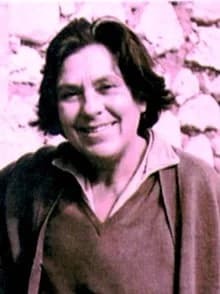
Memorial Page for Halet Çambel
Turkish archaeologist
Memorial Candles
Condolence Book
0 Entries
Memories
No memories shared yet
Be the first to share a memory.
Biography
Halet Çambel (born 27 August 1916 in Berlin; died 12 January 2014 in Istanbul) was a Turkish archaeologist, university teacher and fencer. In 1936 she was among the first Turkish women to compete at the Olympic Games, and later became a defining scholar of Anatolian archaeology. Her name is especially linked with Karatepe-Aslantaş, where research, conservation, landscape and local community were treated as connected.
Origins and education
Çambel was born in Berlin. Her father Hasan Cemil Çambel was close to Mustafa Kemal Atatürk, and her grandfather İbrahim Hakkı Pasha was an Ottoman statesman and diplomat. After the family returned to Turkey, she grew up in an environment in which education, republican ideals and international experience were closely connected. She attended the American College for Girls in Istanbul, later studied in Paris and turned to archaeology.
Berlin 1936
As a fencer Çambel represented Turkey at the 1936 Olympic Games in Berlin. The women's foil competition began on 4 August 1936; in sporting terms she was eliminated early. Historically, however, her participation remained significant because she belonged to a small group of Turkish women taking visible international sporting roles in the early republic. Later she said she had refused a meeting with Adolf Hitler. That episode fits her political awareness and stands beside a much larger scholarly life.
Karatepe-Aslantaş
After her studies Çambel worked with the German archaeologist Helmuth Theodor Bossert. In the 1940s they began research at Karatepe in southern Anatolia. There they found bilingual inscriptions in Phoenician and Hieroglyphic Luwian, which became important for understanding the Luwian script. Çambel's work made Karatepe not only a findspot, but a long-term research landscape.
Conservation in place
Çambel resisted the idea of removing finds from their landscape and sending them to distant museums. She favoured protection in place, an open-air museum and the involvement of local people. UNESCO describes how at Karatepe-Aslantaş she connected natural setting, archaeology and local craft traditions. Women in the region were supported in weaving and dyeing traditions; conservation therefore also created a social and economic perspective.
Teaching and impact
At Istanbul University Çambel shaped generations of students. She worked on prehistoric and Hittite subjects, supported rescue archaeology and remained connected with Karatepe for decades. Her scholarly style was practical, patient and resistant: she combined precise fieldwork with the question of how cultural heritage can be preserved without displacing people and landscape.
Farewell
Halet Çambel died in Istanbul on 12 January 2014. She was 97 years old. In Turkey and beyond, she remains known as an archaeologist who did not treat ancient evidence in isolation, but as part of a living place: its language, nature and people.
Life Events
4 EventsGeboren in Berlin
1916Halet Çambel wird in Berlin geboren.
Olympiastart in Berlin
1936Çambel tritt im Florettfechten der Frauen bei den Olympischen Spielen in Berlin an.
Schutz für Karatepe-Aslantaş
1958Das Gebiet um Karatepe-Aslantaş wird als Nationalpark geschützt, ein wichtiger Schritt für Çambels Konzept von Erhalt vor Ort.
Gestorben in Istanbul
2014Halet Çambel stirbt im Alter von 97 Jahren in Istanbul.
Obituary
No obituary yet
No obituary has been uploaded for this memorial page yet. If you are one of the loved ones and would like to upload one, you can register as the owner of this memorial page and add it afterward.
Family Tree
- Nail Çakırhan
- Hasan Cemil Çambel
Halet Çambel. Forever remembered.