
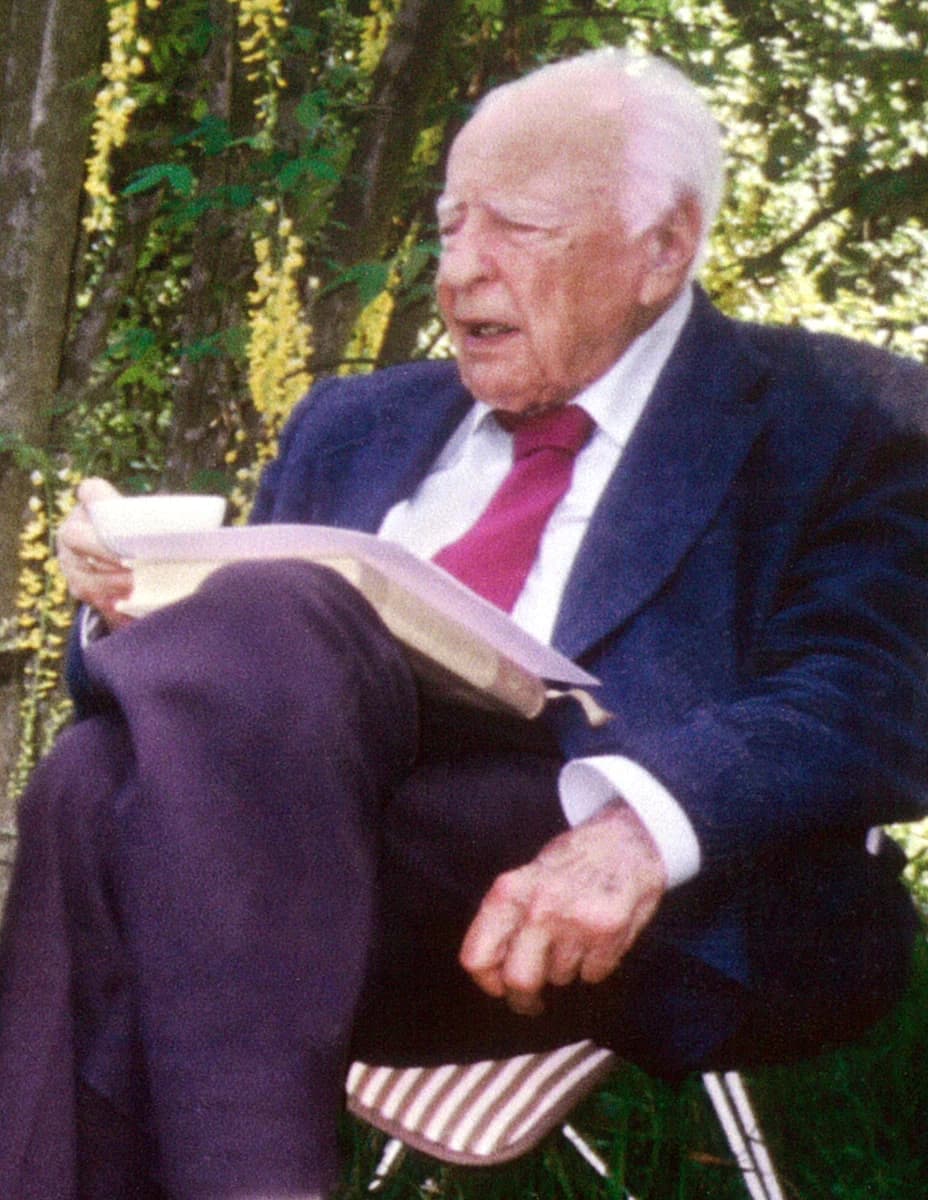
Memorial Page for Hans-Georg Gadamer
German philosopher
Memorial Candles
1 candle

Emoria lights a memorial candle in remembrance of Hans-Georg Gadamer.
Emoria
March 13th, 2026
Condolence Book
0 Entries
Memories
No memories shared yet
Be the first to share a memory.
Biography
Hans-Georg Gadamer (born 11 February 1900 in Marburg; died 13 March 2002 in Heidelberg) was a German philosopher. He is regarded as one of the most important representatives of philosophical hermeneutics. His main work Truth and Method appeared in 1960 and shaped the debate about how human beings understand texts, art, history and one another.
Study and philosophical background
Gadamer grew up as the son of a scientist and studied philosophy and classical philology after the First World War. He learned in an environment shaped by neo-Kantianism, phenomenology, life philosophy and engagement with antiquity. Martin Heidegger became especially important for him; Gadamer received his doctorate under Heidegger in 1922. At the same time, his thinking remained strongly connected with Plato, Aristotle and the classical tradition.
Universities and Heidelberg
Gadamer taught in Marburg, Kiel, Leipzig, Frankfurt am Main and Heidelberg. After the Second World War he worked in Leipzig, later moved to Frankfurt and came to Heidelberg in 1949. There he became a defining figure of postwar German philosophy. He became emeritus in 1968, but remained scholarly active far beyond his official teaching career, giving lectures and taking part in international debates.
Truth and Method
With Truth and Method Gadamer developed his philosophical hermeneutics. He rejected the idea that understanding can be fully explained on the model of neutral method. For him, understanding is historical, linguistic and dialogical. Anyone who understands something does not stand outside tradition, but brings prior assumptions. His idea of the “fusion of horizons” became famous: the movement between the present and transmitted meaning.
Influence and debates
Gadamer's thought influenced philosophy, literary studies, theology, legal theory and art theory. It also remained contested. Critics asked whether his emphasis on tradition grasped power relations and ideology critically enough. These debates made his hermeneutics productive: they forced readers to see understanding not merely as technique, but as a historical and social relation.
Farewell
Hans-Georg Gadamer died in Heidelberg on 13 March 2002, only weeks after his 102nd birthday. His biography connects an unusually long academic life with a philosophy that takes conversation itself seriously: understanding does not arise from the mere application of rules, but through patient engagement with language, history and other people.
Life Events
3 EventsGeboren in Marburg
1900Hans-Georg Gadamer wird in Marburg geboren.
Professor in Frankfurt am Main
1948Gadamer übernimmt eine Professur an der Goethe-Universität Frankfurt am Main.
Gestorben in Heidelberg
2002Hans-Georg Gadamer stirbt im Alter von 102 Jahren in Heidelberg.
Obituary
No obituary yet
No obituary has been uploaded for this memorial page yet. If you are one of the loved ones and would like to upload one, you can register as the owner of this memorial page and add it afterward.
Family Tree
- Käte Gadamer
- Johannes Gadamer
Hans-Georg Gadamer. Forever remembered.