
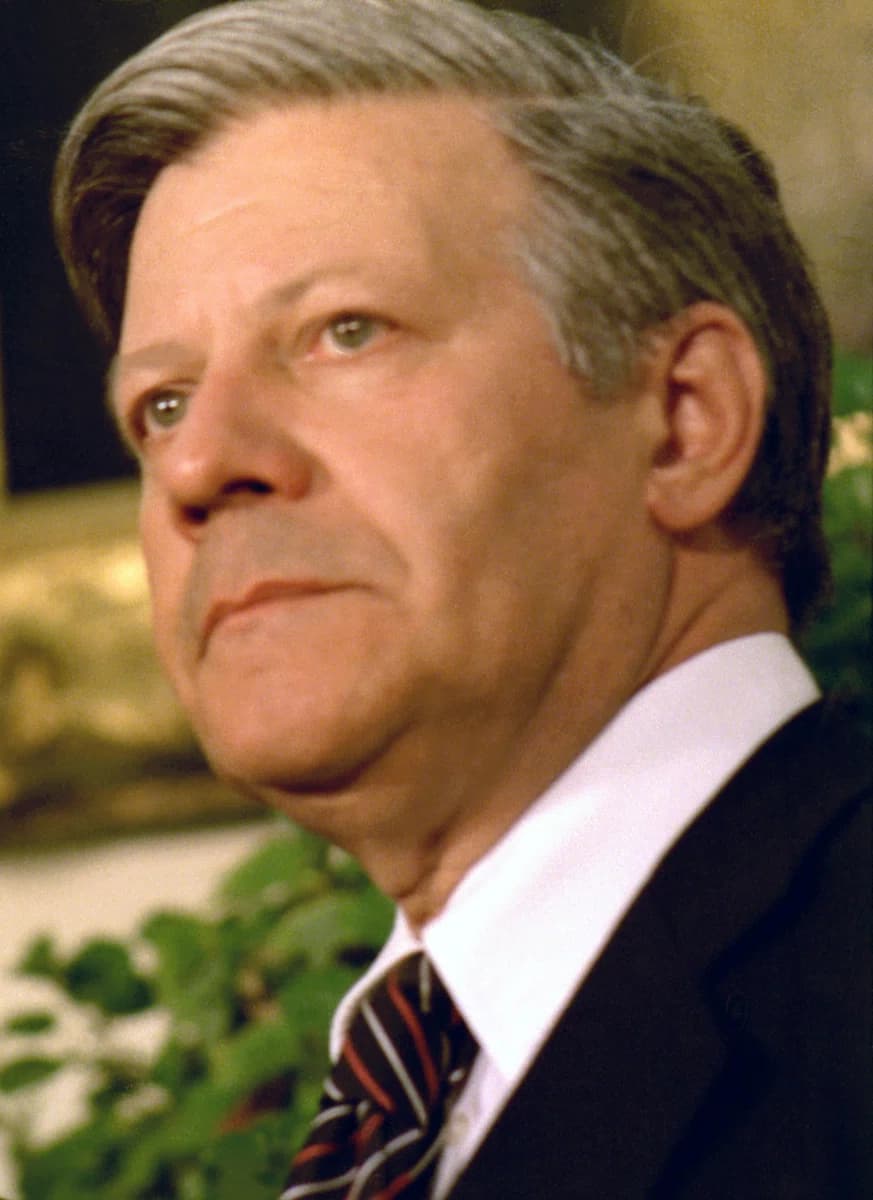
Memorial Page for Helmut Schmidt (née Helmut Heinrich Waldemar Schmidt)
Chancellor of West Germany
Memorial Candles
Condolence Book
0 Entries
Memories
No memories shared yet
Be the first to share a memory.
Biography
Helmut Schmidt (born 23 December 1918 in Hamburg; died 10 November 2015 in Hamburg) was a German Social Democratic politician, chancellor of the Federal Republic of Germany from 1974 to 1982 and later co-publisher of the weekly newspaper Die Zeit. He was regarded as a sober crisis politician, an internationally minded realist and one of the defining public voices of the Bonn Republic. His career joined Hamburg administrative practice, economic competence, security policy and a public judgement that remained audible into old age.
Origins, war and a new beginning
Schmidt was born in Hamburg. His father was a teacher; the family history was also marked by Jewish ancestry on his father’s side. During the Second World War Schmidt served in the Wehrmacht. After 1945 he belonged to a generation that had to orient itself anew in a democratic state. He studied economics in Hamburg, joined the SPD and rose through administration and politics. This mixture of war experience, economic thinking and practical administration shaped his later style.
Hamburg and the flood
Schmidt became nationally known in 1962 as Hamburg’s interior senator during the storm surge. In the night from 16 to 17 February, the disaster hit Hamburg hard; 315 people died in the city alone. Schmidt organised help with a decisiveness that later became his trademark. He called in military and civilian support from Germany and abroad, coordinated helicopter missions and pushed past questions of jurisdiction. His reputation as a crisis manager did not arise from a speech, but from an acute emergency.
Minister in Bonn
After returning to the Bundestag, Schmidt became an important policy specialist within the SPD. In Willy Brandt’s government he first served as defence minister and later as finance minister. He knew the language of budgets, alliances and the international economy. After Brandt’s resignation over the Guillaume affair, Schmidt took over the chancellorship on 16 May 1974. He did not appear as a charismatic renewer, but as a man of concentration who would lead the social-liberal coalition through difficult years.
Chancellor in times of crisis
Schmidt’s chancellorship fell into a period of economic strain. The oil crises, rising unemployment and international uncertainty required political coordination beyond national borders. Together with Valéry Giscard d’Estaing, Schmidt advanced regular world economic summits and helped develop the European Monetary System. He continued Brandt’s détente policy, signed the Helsinki Final Act in 1975 and at the same time kept the Federal Republic firmly embedded in NATO and the European Community.
German Autumn
In 1977 the Federal Republic was shaken by RAF terrorism. The kidnapping of Hanns Martin Schleyer and the hijacking of the Lufthansa aircraft Landshut forced the government into an extreme decision. Schmidt led the crisis unit and decided not to give in to the terrorists’ demands. On 18 October 1977 the GSG 9 freed the hostages in Mogadishu. Shortly afterwards Schleyer was found murdered. These days belong to the darkest moments of the Federal Republic and also show the severity of Schmidt’s understanding of the state: protection of the rule of law without surrender to blackmail.
NATO Dual-Track Decision
Schmidt became even more controversial through his security policy. In view of Soviet SS-20 medium-range missiles, he supported the NATO Dual-Track Decision of 12 December 1979: arms-control negotiations on one hand, possible stationing of new Western medium-range weapons on the other. For Schmidt this was a question of strategic balance. For many in the peace movement, and increasingly in his own party, it was a dangerous course. The conflict contributed to the erosion of the social-liberal coalition.
End of the chancellorship
In 1980 Schmidt was elected chancellor once more. But tensions between the SPD and FDP over economic and fiscal policy, as well as over security policy, grew. On 1 October 1982 his chancellorship ended through a constructive vote of no confidence. Helmut Kohl was elected the new chancellor with votes from the CDU/CSU and parts of the FDP. Schmidt lost office, but remained a political authority.
Publisher and public voice
After leaving active politics, Schmidt became co-publisher of Die Zeit and wrote numerous books, essays and commentaries. He spoke about world politics, economics, Europe, China, the United States, religion, responsibility and the limits of moral certainty in politics. His tone was often concise, sharp and self-confident. That was precisely why he remained present: as a former chancellor who did not merely look back, but judged the present.
Private life and death
Helmut Schmidt had been married to Hannelore “Loki” Schmidt since 1942. Their marriage became a fixed part of his public image without being mere scenery. Loki Schmidt died in 2010. Helmut Schmidt died in Hamburg on 10 November 2015. Many obituaries honoured his discipline, steadiness in crisis and international education, while also recalling his hardness and political decisions that remain debated.
Legacy
Helmut Schmidt’s legacy lies in the connection between pragmatism and responsibility. He was not a politician of grand promises, but of assessing the situation. His strength was the cool view in crises; his limit lay where political sobriety was experienced as inflexibility. In German memory he remains the chancellor of the difficult 1970s, a Hamburger, European, Atlanticist, publisher and a voice that won trust less through warmth than through clarity.
Life Events
9 EventsGeboren in Hamburg
1918Helmut Heinrich Waldemar Schmidt wird in Hamburg geboren.
Krisenmanager der Hamburger Sturmflut
1962Als Hamburger Polizeisenator koordiniert Schmidt die Rettungsmaßnahmen während der Sturmflutkatastrophe.
Bundeskanzler
1974Der Bundestag wählt Helmut Schmidt zum fünften Bundeskanzler der Bundesrepublik Deutschland.
KSZE-Schlussakte in Helsinki
1975Schmidt unterzeichnet die Schlussakte von Helsinki und setzt die Entspannungspolitik fort.
Mogadischu
1977Die GSG 9 befreit die Geiseln der entführten Lufthansa-Maschine Landshut; Schmidt hatte den Einsatz angeordnet.
NATO-Doppelbeschluss
1979NATO beschließt eine Doppelstrategie aus Rüstungskontrolle und möglicher Nachrüstung; Schmidt unterstützt den Kurs gegen starke Kritik.
Als Kanzler wiedergewählt
1980Nach der Bundestagswahl 1980 wird Schmidt erneut zum Bundeskanzler gewählt.
Abwahl durch Misstrauensvotum
1982Der Bundestag wählt Helmut Kohl zum neuen Kanzler; Schmidts Kanzlerschaft endet.
Gestorben in Hamburg
2015Helmut Schmidt stirbt im Alter von 96 Jahren in seiner Heimatstadt Hamburg.
Obituary
No obituary yet
No obituary has been uploaded for this memorial page yet. If you are one of the loved ones and would like to upload one, you can register as the owner of this memorial page and add it afterward.
Family Tree
- Gustav Ludwig Schmidt
- Ludovica Schmidt
Helmut Schmidt (née Helmut Heinrich Waldemar Schmidt). Forever remembered.