Montpelier
Orange

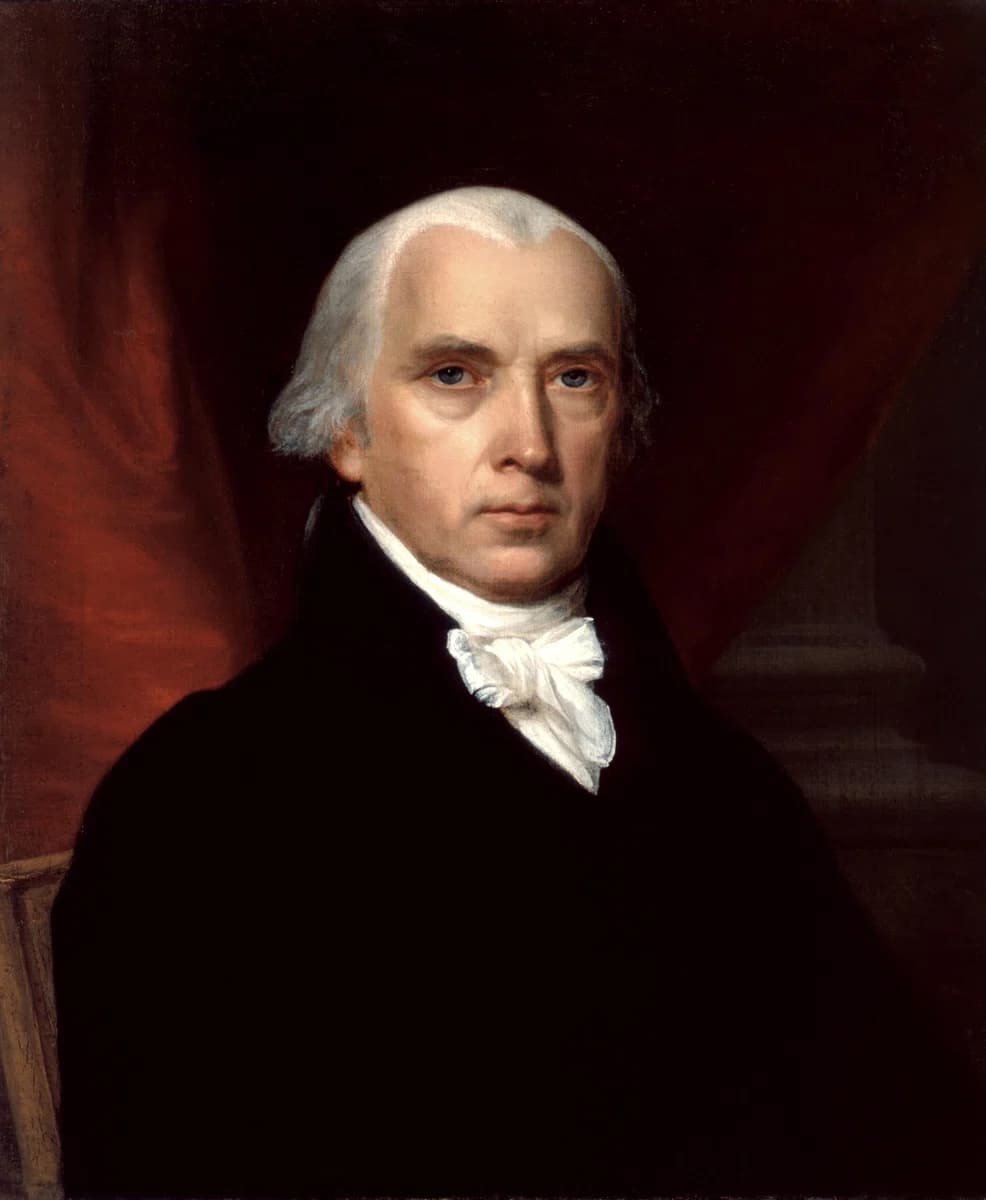
President of the United States from 1809 to 1817
2 candles

Emoria lights a memorial candle in remembrance of James Madison.
Emoria
June 28th, 2026
Emoria lights a memorial candle for James Madison's birthday.
Emoria
March 16th, 2026
0 Entries
James Madison
James Madison (born 16 March 1751 in Port Conway, Virginia; died 28 June 1836 at Montpelier, Virginia) was an American politician, constitutional thinker and the fourth president of the United States. He became known as the "Father of the Constitution" because he helped prepare the Constitutional Convention of 1787, shaped the Virginia Plan and later guided the Bill of Rights through Congress. Madison is one of the central figures of the American founding. His story is incomplete, however, if his role as a plantation owner and enslaver is left aside.

Madison grew up in Virginia and studied at the College of New Jersey, later Princeton University. He was not physically robust, but he worked with unusual intellectual endurance. Early on, he was drawn to the question of how liberty could be protected politically without allowing a majority to exercise unchecked power over minorities. In Virginia he supported religious freedom and also learned the limits of the Revolution: the same society that spoke of liberty rested in large part on enslaved labour.
The weaknesses of the Articles of Confederation convinced Madison that the young republic needed a stronger but limited federal government. In 1787 the Virginia Plan gave the Constitutional Convention a structure that shaped many basic features of the Constitution. Madison was not the Constitution's sole author, but he was one of its most important architects. His notes from Philadelphia remain a central source for the proceedings. With Alexander Hamilton and John Jay, he then wrote essays in The Federalist Papers to argue for ratification.
Madison was initially skeptical of a bill of rights, but he came to see explicit protections as politically and legally necessary. In 1789 he introduced constitutional amendments in the First Congress. They became the first ten amendments, ratified in 1791. They protect religious freedom, freedom of speech, freedom of the press, due process and other rights. This combination is what makes Madison historically important: he worked not only on the structure of government, but also on limits to state power.
From 1801 to 1809 Madison served as secretary of state under Thomas Jefferson. During those years, the Louisiana Purchase became one of the most consequential decisions of the young United States. It doubled the country's territory and opened new political, economic and moral conflicts. Madison defended American commercial rights in a world shaped by the wars between Britain and France. Those tensions followed him into the presidency.
Madison became president in 1809. Four years later, conflict with Britain led to the War of 1812. The decision was disputed, and American military preparation showed serious weaknesses. In 1814 British troops occupied Washington and burned public buildings. The Treaty of Ghent ended the war without clearly resolving the political situation. Even so, the end of the war strengthened a new national self-confidence in the United States. Madison therefore remains a president whose term stood between constitutional ideals, international pressure and military uncertainty.
After 1817 Madison lived again at Montpelier. He remained engaged with public questions and supported the University of Virginia. The deepest contradiction of his life remained slavery. Madison thought about solutions, but he held enslaved people himself and found no way to break fundamentally with the order from which his property benefited. Two facts therefore belong together: Madison helped give rights and checks on power a durable constitutional form; at the same time, his own freedom was tied to the unfreedom of others.
James Madison died at Montpelier on 28 June 1836. His political legacy remains visible because the American Constitution, the Bill of Rights and debates over federal power still return to questions that occupied him. His rank becomes clearer within the tension of his time: Madison was a thinker of liberty, an architect of political order and a man of a society that did not fulfil its own promises of freedom for all people.
James Madison wird in Virginia geboren und wächst später auf dem Familiensitz Montpelier auf.
Madison beginnt am College of New Jersey, der späteren Princeton University, ein intensives Studium.
Madison wirkt in Virginia an der Revolutionspolitik mit und setzt sich früh für Religionsfreiheit ein.
Madison tritt in den Kontinentalkongress ein und gewinnt Erfahrung in der schwierigen Arbeit eines Staatenbundes.
Madison unterstützt Thomas Jeffersons Gesetz zur Religionsfreiheit in Virginia.
Madisons Entwurf prägt den Beginn der Verfassungskonvention in Philadelphia.
Die Verfassung der Vereinigten Staaten wird unterzeichnet; Madisons Notizen werden später eine zentrale Quelle für die Beratungen.
Madison schreibt mit Alexander Hamilton und John Jay Essays zur Verteidigung der neuen Verfassung.
Madison wirbt erfolgreich für die Annahme der Verfassung in seinem Heimatstaat.
Als Abgeordneter bringt Madison Verfassungszusätze ein, aus denen die Bill of Rights hervorgeht.
Die ersten zehn Zusatzartikel zur Verfassung treten in Kraft.
Madison heiratet Dolley Payne Todd, die später eine prägende First Lady wird.
Unter Präsident Thomas Jefferson wird Madison Secretary of State.
Madison ist als Außenminister an der außenpolitischen Umsetzung des Louisiana Purchase beteiligt.
Madison tritt sein Amt als vierter Präsident der Vereinigten Staaten an.
Madison unterzeichnet die Kriegserklärung, mit der der War of 1812 beginnt.
Britische Truppen besetzen Washington und setzen öffentliche Gebäude in Brand; die Krise zeigt die Schwächen der amerikanischen Kriegsführung.
Der Senat ratifiziert den Vertrag von Gent und beendet den Krieg mit Großbritannien.
Madison verlässt das Präsidentenamt und zieht sich nach Virginia zurück.
Madison übernimmt eine wichtige Rolle für die junge University of Virginia.
James Madison stirbt im Alter von 85 Jahren auf Montpelier in Virginia.
No obituary has been uploaded for this memorial page yet. If you are one of the loved ones and would like to upload one, you can register as the owner of this memorial page and add it afterward.
Orange
James Madison (née James Madison, Jr.). Forever remembered.