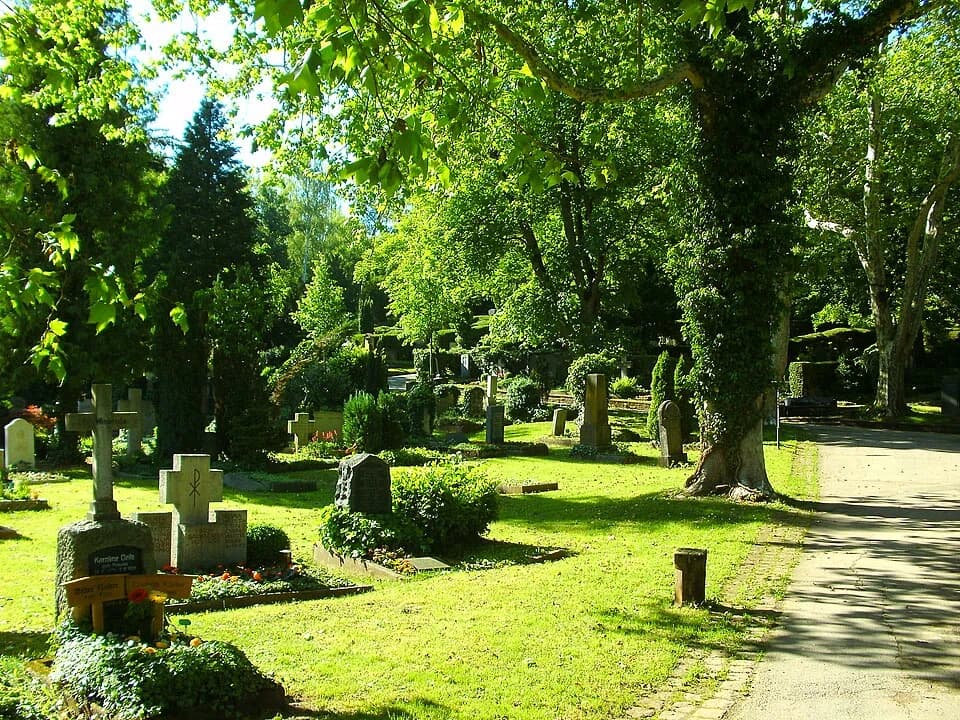
Stadtfriedhof Tübingen
Tübingen


German Reformed theologian
2 candles

Emoria lights a memorial candle in remembrance of Jürgen Moltmann.
Emoria
June 2nd, 2026
Emoria lights a memorial candle for Jürgen Moltmann's birthday.
Emoria
April 8th, 2026
0 Entries
Be the first to share a memory.
Jürgen Moltmann (born 8 April 1926 in Hamburg; died 3 June 2024 in Tübingen) was a German Reformed theologian and university teacher. He became internationally known through works such as Theology of Hope, The Crucified God and God in Creation. His theology connected Christian faith with history, suffering, political responsibility, ecumenism and the question of a hope that does not flee reality.
Moltmann grew up in Hamburg and was initially more interested in mathematics and physics than in theology. The Second World War broke off that path. As a teenager he experienced the destruction of Hamburg, was drafted into military service and became a British prisoner of war in 1945. In camps in Belgium, Scotland and England he encountered the Bible, Christian reconciliation work and the question of how one can still speak of God after guilt, death and destruction. From that experience came not simple consolation, but a lifelong theological search.
After returning to Germany, Moltmann studied theology in Göttingen. In 1952 he married theologian Elisabeth Moltmann-Wendel, who later became an important voice in feminist theology. Moltmann first worked as a pastor and then taught at the Theological College Wuppertal, later at the University of Bonn. In 1967 he became professor of systematic theology and social ethics at the University of Tübingen, where he taught until his retirement in 1994 and remained active far beyond it.
With Theology of Hope, Moltmann became internationally known in 1964. The book presented hope not as private consolation, but as a force that changes the present. For Moltmann, Christian faith did not mean withdrawal from the world, but expectation of God's future, moving people toward critique, commitment and solidarity. In this way he spoke into a time of Cold War, political reorientation, student movements and ecumenical renewal.
In 1972 Moltmann published The Crucified God. In it he placed the suffering of Christ at the center of Christian speech about God. For Moltmann, God was not distant from the suffering of the world, but connected in the cross itself with the abandoned and humiliated. These thoughts were also an answer to Auschwitz and to the question of how theology could remain responsible after the crimes of the twentieth century.
Moltmann wrote about church, Trinity, creation, ecology, peace and political responsibility. He was read worldwide, lectured on several continents and took part in ecumenical debates, including in the orbit of the World Council of Churches. His language remained theologically demanding, but it aimed at public questions: What sustains hope in crises? How are faith, justice and freedom connected? And how can one speak of creation without treating the earth merely as human property?
Jürgen Moltmann died in Tübingen on 3 June 2024. He was 98 years old. His work remains one of the most influential Protestant voices in contemporary theology. It connects personal wartime experience, scholarly work and a hope that is not harmless and does not bypass suffering, guilt or responsibility.
Jürgen Moltmann wird in Hamburg geboren.
Jürgen Moltmann stirbt im Alter von 98 Jahren in Tübingen.
No obituary has been uploaded for this memorial page yet. If you are one of the loved ones and would like to upload one, you can register as the owner of this memorial page and add it afterward.
Tübingen
Jürgen Moltmann. Forever remembered.