
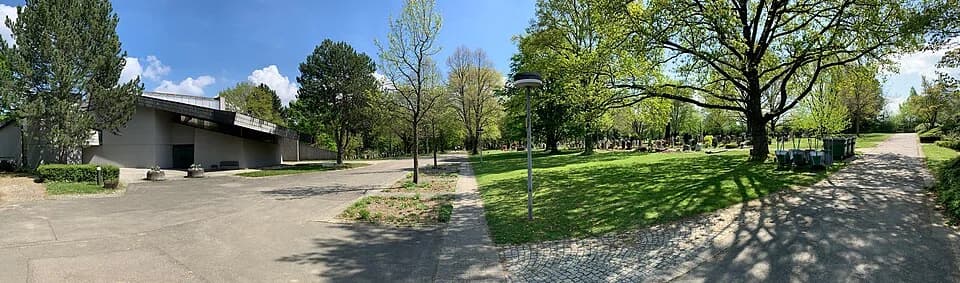
Ostfilderfriedhof
Stuttgart-Gablenberg

German politician
0 Entries
Be the first to share a memory.
Manfred Rommel (born 24 December 1928 in Stuttgart; died 7 November 2013 in Stuttgart) was a German lawyer, CDU politician, long-serving Lord Mayor of Stuttgart and author. From 1975 to 1996 he shaped the capital of Baden-Württemberg through liberal integration policy, sound finances, international openness and a dry humor that became known far beyond Stuttgart.
Rommel was the only son of Erwin Rommel and Lucie Rommel. As a teenager he experienced National Socialism not as an abstraction, but inside his own family home: in 1944 his father was forced to die by suicide by the Nazi leadership, while the public was told another cause of death. Manfred Rommel later spoke about this experience without pathos. It became part of the background to his political stance: distrust of fanaticism, respect for law and dignity, and a clear aversion to ideological hardness.
After the war and captivity, Rommel studied law. He worked in the administration of Baden-Württemberg, including in the circles of state premiers and ministries, and became state secretary for finance. This administrative training shaped him: Rommel did not think of local politics only in large words, but in budgets, responsibilities, transport, schools, housing and the long consequences of individual decisions.
On 1 December 1974 Rommel was elected Lord Mayor; on 1 January 1975 he took office. During his 22 years at the head of the city, important structures for the region were created or expanded, including the Stuttgart transport and tariff association, S-Bahn development, event and congress facilities and international city partnerships. Stuttgart remained an industrial city, but also became more visibly a city of science, culture and integration.
Rommel was regarded as a conservative politician with a liberal instinct. This became especially visible in 1977 after the deaths of RAF members Andreas Baader, Gudrun Ensslin and Jan-Carl Raspe in Stuttgart-Stammheim. Against strong protests, he allowed their burial at the Dornhalden cemetery. His sentence "Mit dem Tod muss jede Feindschaft enden" became a formula for an attitude that holds on to the rule of law and humanity even when public outrage is intense.
Under Rommel, Stuttgart became known for a comparatively open policy toward foreign residents. He regarded immigrants not merely as workers, but as part of the urban community. Internationally, too, he sought understanding. Friendships with relatives of former wartime opponents and his contacts with France, Britain and the United States did not turn his life into a simple story of reconciliation, but they showed credible work toward understanding after the war.
Rommel wrote books, speeches and aphorisms. His humor was often Swabian in its brevity, dry and self-ironic. He could soften political hardness without denying conflict. This mixture of thrift, wit and moral clarity made him one of the best-known local politicians in the Federal Republic.
Manfred Rommel died in Stuttgart on 7 November 2013. He was 84 years old. His political weight lay less in major national offices than in a local practice that brought everyday life, decency and openness together.
Manfred Rommel wird in Stuttgart als Sohn von Erwin und Lucie Rommel geboren.
Rommel wird mit 58,9 Prozent der Stimmen zum Stuttgarter Oberbürgermeister gewählt.
Rommel ermöglicht die gemeinsame Beisetzung von Andreas Baader, Gudrun Ensslin und Jan-Carl Raspe in Stuttgart.
Manfred Rommel stirbt im Alter von 84 Jahren in Stuttgart.
No obituary has been uploaded for this memorial page yet. If you are one of the loved ones and would like to upload one, you can register as the owner of this memorial page and add it afterward.
Stuttgart-Gablenberg
Manfred Rommel. Forever remembered.