Panthéon
5th arrondissement of Paris

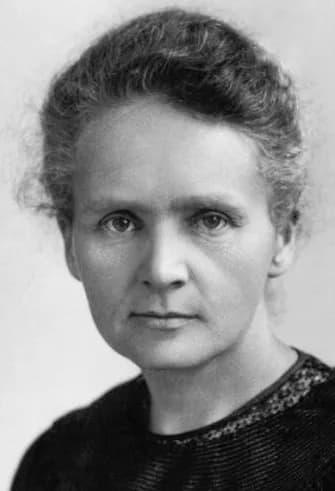
Polish-French physicist and chemist
1 candle
Emoria lights a memorial candle in remembrance of Marie Curie.
Emoria
July 4th, 2026
0 Entries
48 memories

Marie Curie's 1921 visit to the United States.

Ramsay, William - Curie, Pierre - Curie, Marie CIPA0591

Official proceedings (1921) (14574645738)

Annual report of the trustees of the American Museum of Natural History for the year (1921) (19341550566)

Solvay conference 1927
![Marie Curie with Albert Einstein [1]](/_next/image?url=%2Fapi%2Fmedia%3Fkey%3Dmedia%252Fcommons%252Ffamouspersonimage%252Fcmljdmt0g00tnubtotfv6av21_320w.webp%26sig%3De470f5b908fd46238457365cd8591661b00810d57112318f2952889b2a1b6ba2%26exp%3D1790136741&w=1920&q=75)
Marie Curie with Albert Einstein [1]

Solvay conference 1930

Third Solvay Conference, 1921

Solvay1933Large

Depicted person: Marie Curie

Marie Curie explains to a group of nurses the potential benefits of radium treatment photographic print

Irène, Marie et Ève Curie
Marie Curie (born Maria Skłodowska on 7 November 1867 in Warsaw; died 4 July 1934 at the Sancellemoz sanatorium in Haute-Savoie) was a Polish-French physicist and chemist. She shaped the study of radioactivity, discovered the elements polonium and radium with Pierre Curie and Gustave Bémont, and became the first person to receive two Nobel Prizes. Her work led from a modest Paris laboratory into 20th-century medicine.

Maria Skłodowska grew up in Warsaw in a family of teachers. Poland was then under Russian rule, and women had limited access to higher education. She continued learning nevertheless, worked for a time as a governess and in 1891 followed her sister to Paris. At the Sorbonne she studied physics and mathematics under difficult financial conditions. These years already show what would define her later life: discipline, scientific precision and an almost uncompromising seriousness toward education.
In 1894 she met Pierre Curie, a physicist with his own established research. Their marriage also became a working partnership, but Marie Curie was never a secondary figure in Pierre's laboratory. For her doctoral research she studied the rays from uranium observed by Henri Becquerel and turned them into a systematic programme of measurement. The word radioactivity became associated with this work. In 1898 the Curies announced first polonium, named for Marie's country of origin, and then radium as new elements.

In 1903 Marie Curie received the Nobel Prize in Physics together with Pierre Curie and Henri Becquerel. That same year she earned her doctorate in Paris. After Pierre's accident in 1906, she continued the work and took over his chair at the Sorbonne, becoming the first woman to hold that position. In 1911 she received the Nobel Prize in Chemistry for her work on radium and polonium. Curie thereby became an exceptional scientific figure, but she remained above all a researcher: her authority rested on measurement, endurance and the ability to draw new knowledge from the smallest traces.
Curie understood early that radioactivity was not only a physical phenomenon, but also opened medical possibilities. This idea helped lead to the Radium Institute in Paris, where laboratory science and medicine were meant to work together. During the First World War she applied her knowledge practically: she organized mobile X-ray units that helped wounded soldiers near the front by making shrapnel and bone fractures visible. Her daughter Irène worked with her. This work was not glamorous, but concrete, technical and urgent.

After the war Curie remained closely connected with radium research and medical application. In 1921 she travelled to the United States, where a fundraising campaign provided one gram of radium for her work. The creation and support of laboratories in Paris and Warsaw also belonged to her life's work. Curie did not seek loud fame. She used her visibility to make research possible, train younger scientists and strengthen international cooperation.
Marie Curie died on 4 July 1934 at the Sancellemoz sanatorium in Haute-Savoie. Contemporary and later accounts connect her illness with long exposure to radioactive substances and unshielded X-ray work, although the dangers were not yet sufficiently understood in her time. In 1995 Marie and Pierre Curie were transferred to the Pantheon in Paris. Her name stands not only for two Nobel Prizes, but for a form of science that joined precision, courage and responsibility.
Maria Skłodowska, später bekannt als Marie Curie, wird im damals russisch beherrschten Warschau geboren.
Sie geht nach Paris und beginnt an der Sorbonne ihr Studium der Naturwissenschaften.
Marie Skłodowska erwirbt an der Sorbonne den Abschluss in Physik.
In Paris lernt sie den Physiker Pierre Curie kennen, mit dem sie bald wissenschaftlich zusammenarbeitet.
Marie Skłodowska und Pierre Curie heiraten in Sceaux bei Paris.
Marie und Pierre Curie berichten über ein neues radioaktives Element und nennen es nach Maries Herkunftsland Polonium.
Die Curies und Gustave Bémont geben die Entdeckung von Radium bekannt.
Marie Curie promoviert über radioaktive Substanzen und wird damit eine führende Forscherin auf diesem neuen Gebiet.
Marie Curie erhält gemeinsam mit Pierre Curie und Henri Becquerel den Nobelpreis für Physik.
Nach dem Verlust Pierre Curies übernimmt Marie Curie dessen Lehrstuhl und wird die erste Frau in dieser Position an der Sorbonne.
Sie erhält den Nobelpreis für Chemie für ihre Arbeiten zu Radium und Polonium.
Im Ersten Weltkrieg organisiert Curie mobile Röntgeneinheiten für Verwundete nahe der Front.
Auf einer USA-Reise nimmt Curie ein Gramm Radium entgegen, finanziert durch eine amerikanische Spendenkampagne für ihre Forschung.
Marie Curie stirbt im Sanatorium Sancellemoz in Haute-Savoie.
Marie und Pierre Curie werden in das Pariser Panthéon überführt; Marie Curie ist die erste Frau, die dort für eigene Verdienste beigesetzt wird.
No obituary has been uploaded for this memorial page yet. If you are one of the loved ones and would like to upload one, you can register as the owner of this memorial page and add it afterward.
5th arrondissement of Paris
Marie Curie (née Marya Salomea Skłodowska). Forever remembered.