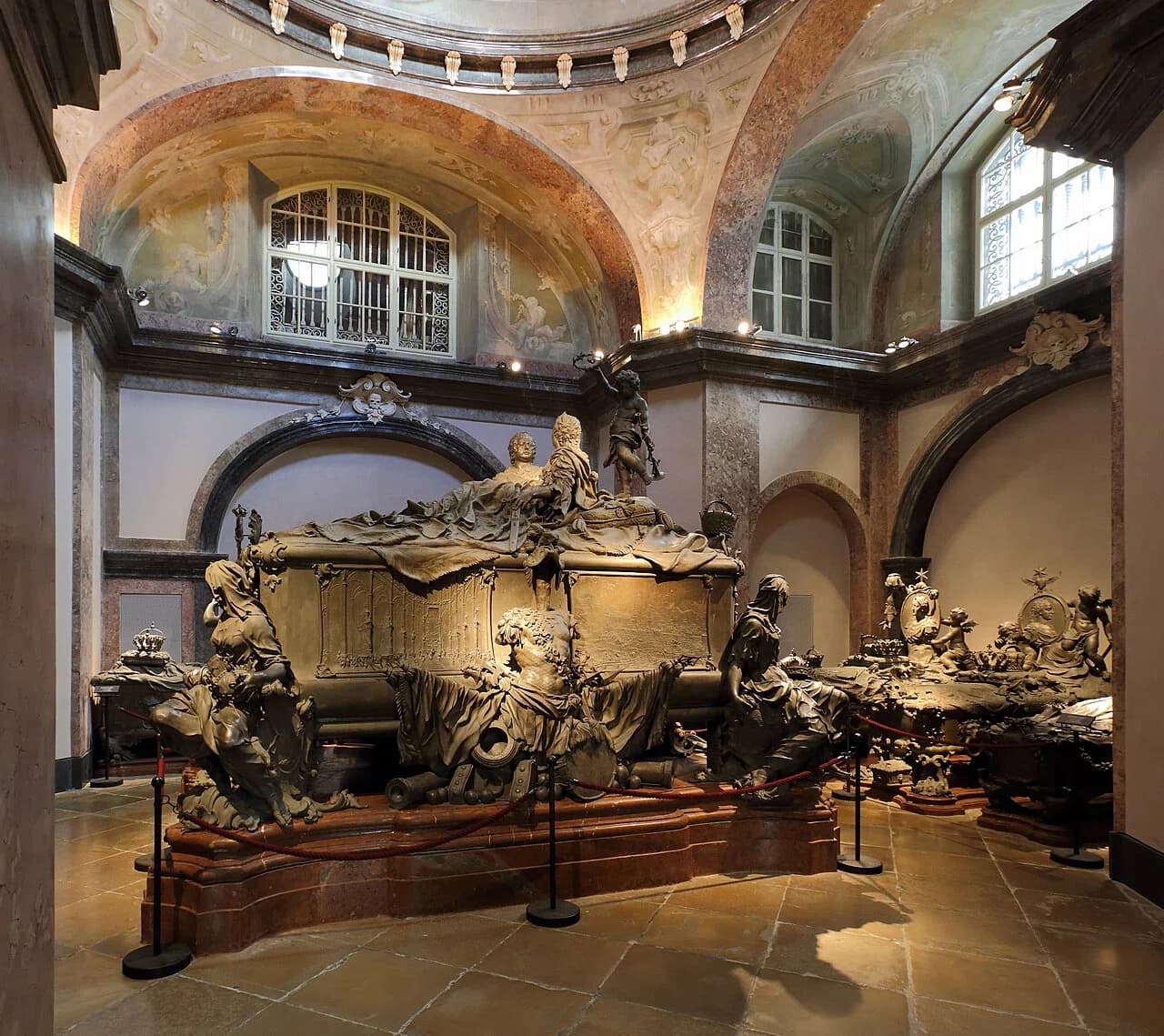
Kapuzinergruft
Wien, Innere Stadt


Head of the House of Habsburg and German politician
1 candle
Emoria lights a memorial candle in remembrance of Otto von Habsburg.
Emoria
July 4th, 2026
0 Entries
Otto von Habsburg
Otto von Habsburg (born 20 November 1912 in Reichenau an der Rax; died 4 July 2011 in Pöcking) was the last crown prince of Austria-Hungary, a writer and a politician. After the end of the monarchy he spent much of his life in exile. Later he became an advocate of European integration and served from 1979 to 1999 as a CSU member of the European Parliament.
Otto was born as the eldest son of the later Emperor Karl I and Empress Zita. When Karl took the throne in 1916, Otto became crown prince. The monarchy collapsed as early as 1918. For Otto this meant a childhood and youth without the political world into which he had been born. The family lived in exile after the war. The former heir to the throne became a political figure whose life remained accompanied by questions of republic, dynasty and European order.
In the 1930s Otto von Habsburg clearly opposed Austria's annexation by National Socialist Germany. During the Second World War he lived abroad and argued in writing and politics for Austria's future outside the Nazi regime. This stance made him an opponent of the National Socialists. After 1945 his return to Austria nevertheless remained politically contested, because the Habsburg Law regulated the status of former members of the ruling house.
On 31 May 1961 Otto Habsburg-Lothringen signed a declaration renouncing claims to rule and declaring himself a citizen of the Republic of Austria. The declaration triggered political disputes known as the Habsburg crisis. Only after several legal and political steps was his entry into Austria again possible. This phase shows how long the consequences of the monarchy continued to shape the Second Republic.
His later public role did not lie in the restoration of a monarchy, but in European politics. Otto von Habsburg became president of the International Paneuropean Union and advocated a united Europe that should also include Central and Eastern Europe. In 1979 he was elected for the CSU in the first direct election to the European Parliament. He remained there until 1999 and repeatedly argued for Europe's opening toward the East.
On 19 August 1989 the Pan-European Picnic at the Hungarian-Austrian border was held under the patronage of Otto von Habsburg and Imre Pozsgay. The temporary border opening became an important symbol on the path toward the end of the Iron Curtain. Otto von Habsburg died in Pöcking on 4 July 2011. His biography stretches from the last phase of the Habsburg monarchy to European integration after the Cold War.
Otto von Habsburg wird als ältester Sohn von Karl und Zita von Habsburg-Lothringen geboren.
Nach der Thronbesteigung seines Vaters Karl wird Otto Kronprinz der Habsburgermonarchie.
Otto von Habsburg heiratet Regina Prinzessin von Sachsen-Meiningen.
Otto Habsburg-Lothringen erklärt den Verzicht auf Herrschaftsansprüche und bekennt sich als österreichischer Staatsbürger.
Bei der ersten Direktwahl zum Europäischen Parlament wird Otto von Habsburg für die CSU gewählt.
Das Picknick an der ungarisch-österreichischen Grenze steht unter seiner Schirmherrschaft und wird zu einem Symbol der Grenzöffnung.
Otto von Habsburg stirbt im Alter von 98 Jahren in Pöcking in Bayern.
No obituary has been uploaded for this memorial page yet. If you are one of the loved ones and would like to upload one, you can register as the owner of this memorial page and add it afterward.
Wien, Innere Stadt
Otto von Habsburg (née Franz Joseph Otto Robert Maria Anton Karl Max Heinrich Sixtus Xaver Felix Renatus Ludwig Gaetan Pius Ignatius Habsburg). Forever remembered.