/

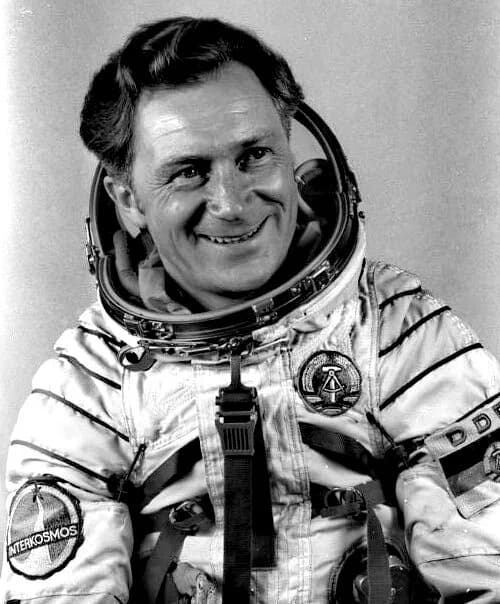
Photo: 📷 Peter Koard
Biography of Sigmund Jähn
13. Feb 1937 – 21. Sep 2019(82 years)Died in:Strausberg, Brandenburg
East German cosmonaut
0
Candles
0
Condolences
0
Family Tree
Biography
Nationality
German Democratic Republic
Children
2
Awards(10)
honorary citizen of BerlinMeritorious Military Pilot of the German Democratic RepublicGold medal with hero rank of GDRHero of the Soviet UnionPilot-Cosmonaut of the German Democratic RepublicGolden HenOrder of LeninOrder of Karl MarxMedal "For Merit in Space Exploration"Medal of Merit of the National People's Army
Education(4)
Franz Mehring Military AcademyOtto Lilienthal Military AcademyGagarin Air Force AcademyCentral Institute for Earth Physics
Sigmund Werner Paul Jähn (born 13 February 1937 in Morgenröthe-Rautenkranz; died 21 September 2019 in Strausberg) was a German pilot, cosmonaut, scientist and major general in the National People's Army of the GDR. On 26 August 1978, aboard Soyuz 31, he became the first German in space. His spaceflight began in the Cold War, was politically charged in East Germany and gained a second meaning after 1990: Jähn later helped German and European astronauts work with Russia.
Vogtland, printing and aviation
Jähn grew up in the Saxon Vogtland region. After school he first trained as a book printer before joining the East German air force in 1955. There he became a pilot, later an officer and instructor. His military path also led him to the Yuri Gagarin Air Force Academy near Moscow, where he studied until 1970. This combination of flying, technical discipline and Soviet training made him a candidate for the Intercosmos program.
Intercosmos and Soyuz 31
In 1976 the GDR sent several candidates to the cosmonaut training center at Star City near Moscow; Jähn was selected together with Eberhard Köllner. On 26 August 1978 he launched with Soviet commander Valery Bykovsky to the Salyut 6 space station. During the flight he carried out scientific experiments in fields including remote sensing, medicine, biology, materials science and geophysics. After seven days, 20 hours and 49 minutes, he returned to Earth on 3 September 1978 aboard Soyuz 29.
A spaceflight in divided Germany
Jähn's flight was scientific, but also politically charged. East Germany celebrated him as a socialist hero, while West Germany would send Ulf Merbold into space only a few years later. In later years Jähn himself seemed less interested in pathos than in spaceflight as a shared task. For that reason he was remembered after German reunification not only as a GDR icon, but also as an expert able to build bridges between East and West.
After reunification
After the dissolution of the East German armed forces in 1990, Jähn was discharged from the military. He then worked as a consultant for the German Aerospace Center and the European Space Agency. At Star City, he supported European astronauts preparing for Mir missions. This second professional phase mattered because it made his experience of the Soviet space system useful for European spaceflight.
Science and memory
Jähn completed a doctorate in 1983 on remote sensing of Earth; material from his spaceflight formed part of that work. He remained connected with spaceflight, Earth observation and international cooperation. Many remembered him not only as the first German in space, but as a calm, down-to-earth person who knew the historical importance of his flight without turning it into self-display.
Farewell
Sigmund Jähn died in Strausberg on 21 September 2019. He was 82 years old. His life stands for a chapter of German space history that cannot be understood without the political conditions of the Cold War, yet points beyond them: toward science, cooperation and the view of Earth as a shared home.
Life Events
10 Events1937
Born in Morgenröthe-Rautenkranz, Vogtlandkreis
1977
Meritorious Military Pilot of the German Democratic Republic
1978
Gold medal with hero rank of GDR
1978
Hero of the Soviet Union
1978
Order of Lenin
1978
Order of Karl Marx
1978
Pilot-Cosmonaut of the German Democratic Republic
1999
Golden Hen
2011
Medal "For Merit in Space Exploration"
2019