
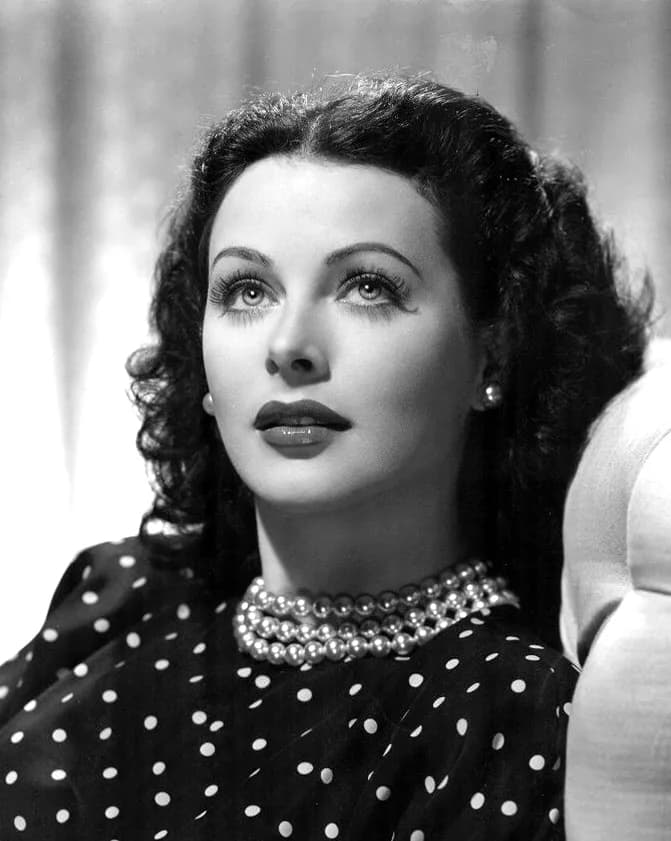
Biography of Hedy Lamarr
9. Nov 1914 – 19. Jan 2000(85 years)Died in:Casselberry, Seminole County
Austrian-American actress and co-inventor of an early technique for spread spectrum communications and frequency hopping
0
Candles
0
Condolences
5
Family Tree
Biography
Burial Place
Vienna Central Cemetery
Spouse(6)
Hedy Lamarr (born Hedwig Eva Maria Kiesler on 9 November 1914 in Vienna; died 19 January 2000 near Orlando, Florida) was an Austrian-American actress and inventor. In Hollywood she became a film star in the 1930s and 1940s. Later, more attention was given to the fact that she and George Antheil patented a frequency-hopping system now regarded as an important precursor in wireless communication.
Vienna and European film
Lamarr grew up in Vienna and began acting early. Under her birth name Hedwig Kiesler she appeared in European productions. The 1933 film Ecstasy made her internationally known and controversial. After her marriage to industrialist Fritz Mandl, she left Europe and reached Hollywood. MGM gave her the name Hedy Lamarr and shaped her into the image of a mysterious European beauty.
Hollywood
Her American breakthrough came in 1938 with Algiers. In the following years Lamarr appeared in many Hollywood films, often in roles strongly defined by beauty, exoticism and distance. Among her best-known films is Cecil B. DeMille's Samson and Delilah. This career made her famous, but it often narrowed public attention away from her intelligence, technical curiosity and independence.
Secret Communication System
During the Second World War Lamarr worked with composer George Antheil on an idea for jam-resistant radio control. Their Secret Communication System was designed to make radio signals hop between changing frequencies, making control signals harder to jam or intercept. The patent application was filed on 10 June 1941; US patent 2,292,387 was granted on 11 August 1942. The invention was not used during the war in the form they had imagined.
Late recognition
For a long time Lamarr was remembered mainly as a film star. Only late in life did her technical work receive wider attention. In 1997 the Electronic Frontier Foundation honored her with a Pioneer Award; in 2014 she was inducted into the National Inventors Hall of Fame. The precise framing matters: Lamarr did not single-handedly invent modern Wi-Fi or Bluetooth, but her patent is among the early works later reread in connection with spread-spectrum and frequency-hopping techniques.
Farewell
Hedy Lamarr died in Florida on 19 January 2000. Her biography connects film history, exile, technical curiosity and the late correction of a one-sided public image. That combination still makes her distinctive: she was not only a Hollywood projection, but also an inventor whose work was properly noticed only decades later.
Life Events
11 Events1914
Born in Vienna, Austria
1933
Married Friedrich Mandl
until 1937
1939
Married Gene Markey
until 1941
1943
Married John Loder
until 1947
1951
Married Teddy Stauffer
until 1952
1953
Married W. Howard Lee
until 1960
1963
Married Lewis J. Boies
until 1965
1997
EFF Award
2000
Died in Casselberry, Seminole County (cardiovascular disease)
2014
National Inventors Hall of Fame
frequency-hopping spread spectrum
2025