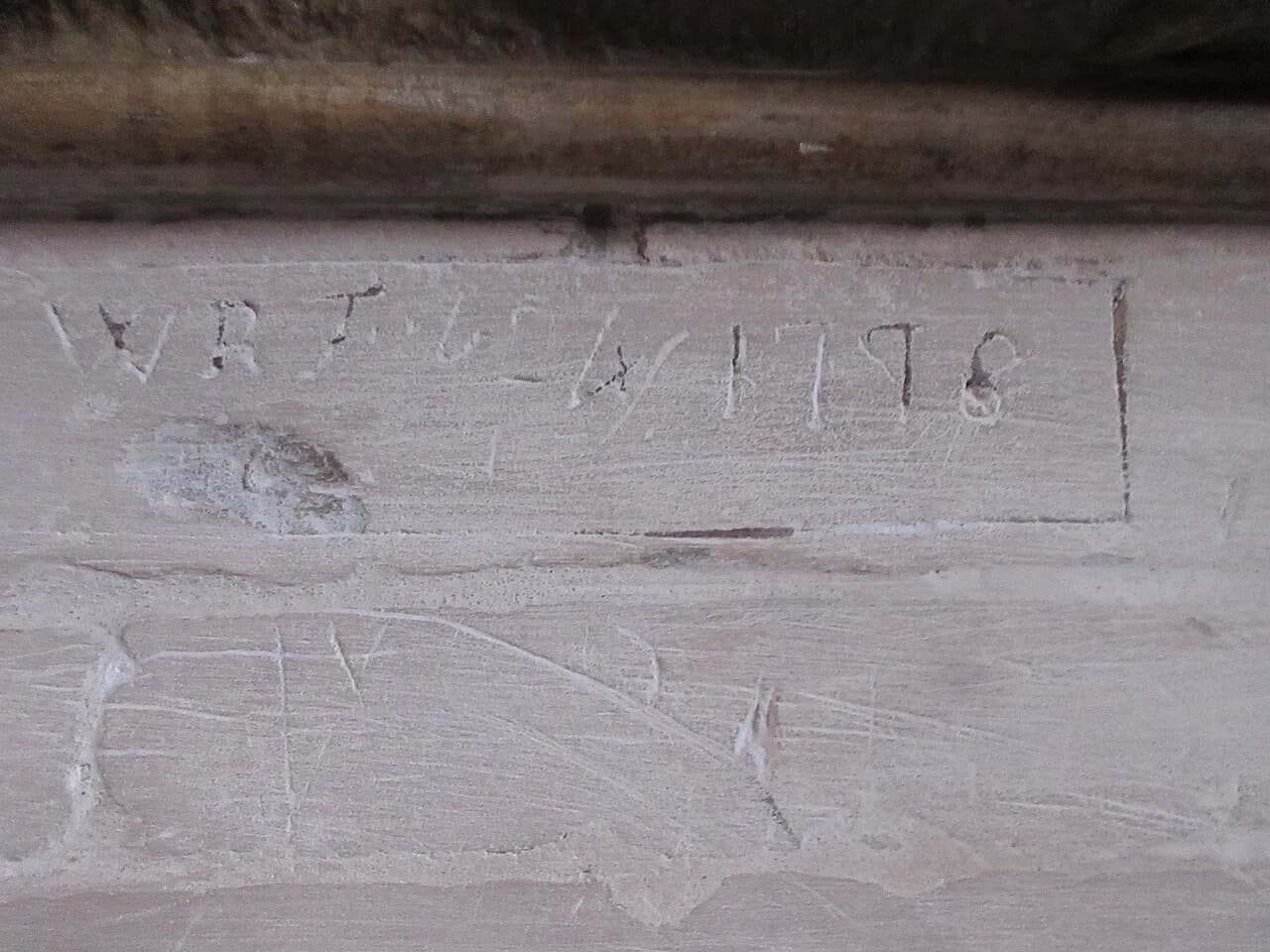
Westminsterabtei
City of Westminster


English mathematician and physicist
1 candle
Emoria lights a memorial candle in remembrance of Isaac Newton.
Emoria
March 20th, 2026
0 Entries
22 memories

Revised academic genealogy of Isaac Newton from Academic Family Tree

Monument to Isaac Newton over his tomb in Westminster Abbey, London

A replica of Isaac Newton's second reflecting telescope of 1672.

Newtonmas Tree

Boullée, Cénotaphe à Newton, 1784, Graphik

Portrait of Isaac Newton (1642-1727)

Isaac Newton, English School, 1715-20

Newton - 1677

woodcut portrait of Isaac Newton, after a 17th-century portrait by Kneller

Sir Isaac Newton (1642–1727) by William Theed (1804–1891), 1858, bronze; St Peter's Hill, Grantham. View from the front.

Sir Isaac Newton by Sir Godfrey Kneller, Bt

Frontispiece, Observations upon the Prophecies of Daniel and the Apocalypse of St. John
Isaac Newton (born 4 January 1643 in Woolsthorpe, Lincolnshire; died 31 March 1727 in Kensington) was an English mathematician, physicist, astronomer and natural philosopher. Under the Julian calendar then used in England, he was born on 25 December 1642 and died on 20 March 1727. Newton's work fundamentally changed the understanding of motion, light, gravitation and mathematical natural philosophy.

Newton was born at Woolsthorpe Manor in Lincolnshire. His father had died before his birth; his childhood was marked by family disruption and an early inclination toward mechanical models, drawings and observation. After school in Grantham, Newton entered Trinity College, Cambridge, in 1661. There he encountered the mathematics, astronomy and natural philosophy of his time and began testing older authorities through his own calculations and experiments.
When plague forced Cambridge to close in 1665 and 1666, Newton returned to Woolsthorpe. This period was later heavily mythologized, but it was genuinely decisive: Newton worked on methods of calculus, motion and optical questions. The famous apple story is only a compressed image for a deeper problem: how could the same force be imagined that makes a body fall to Earth and also describes the motion of the Moon?
Newton studied light experimentally, not only speculatively. With prisms he showed that white light consists of differently coloured components and that colour is not simply produced by glass altering light. His reflecting telescope belonged to the same way of thinking: it was designed to avoid optical defects in lens telescopes. In 1672 Newton became a Fellow of the Royal Society after his telescope attracted major attention there.

Newton's Philosophiae Naturalis Principia Mathematica appeared in 1687. The work joined mathematics, celestial mechanics and physics with unprecedented rigor. Newton formulated the three laws of motion and universal gravitation. Falling bodies on Earth, planetary orbits and many astronomical phenomena could now be described within a single theoretical framework. The Principia became a foundational book of modern science.

Newton was not only a Cambridge scholar. In 1696 he moved to London to work at the Royal Mint and later became Master of the Mint. He took the role seriously, worked on the recoinage and pursued counterfeiters with severity. In 1703 he became president of the Royal Society, and in 1705 he was knighted. In these years Newton was a public authority: scientist, administrator, powerful institutional figure and fierce defender of his priorities.
Isaac Newton died in Kensington on 31 March 1727 and was buried in Westminster Abbey. His grave and monument made clear the rank British public life gave him. Newton's significance does not lie in a single idea, but in making natural processes mathematically describable. After him the world was not simpler, but more calculable: motion, force, light and celestial mechanics became part of a shared language.
Isaac Newton wird in Woolsthorpe in Lincolnshire geboren; nach dem damals in England geltenden julianischen Kalender war es der 25. Dezember 1642.
Newton beginnt sein Studium am Trinity College in Cambridge.
Während der Schließung Cambridges durch die Pest arbeitet Newton in Woolsthorpe an Grundlagen von Analysis, Optik und Bewegung.
Newton wird Lucasian Professor of Mathematics an der Universität Cambridge.
Newtons Spiegelteleskop wird der Royal Society vorgestellt; im selben Jahr wird er Fellow der Gesellschaft.
Die Philosophiae Naturalis Principia Mathematica werden veröffentlicht und formulieren Bewegungsgesetze und universelle Gravitation.
Newton wechselt nach London und übernimmt ein Amt an der Royal Mint.
Newton wird Präsident der Royal Society und prägt die britische Wissenschaftsöffentlichkeit für Jahrzehnte.
Newton veröffentlicht Opticks, seine große Darstellung von Experimenten und Theorien zu Licht und Farbe.
Isaac Newton stirbt in Kensington; nach dem damals in England geltenden Kalender war es der 20. März 1727.
No obituary has been uploaded for this memorial page yet. If you are one of the loved ones and would like to upload one, you can register as the owner of this memorial page and add it afterward.
City of Westminster
Isaac Newton. Forever remembered.