/
Biography
Occupation(13)
Awards(9)
Spouse(3)
Education(1)
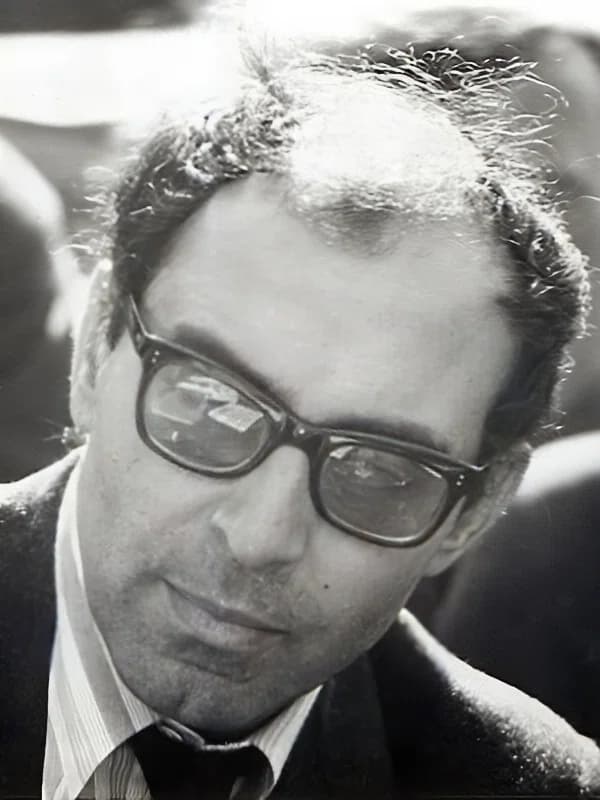
Jean-Luc Godard (born 3 December 1930 in Paris; died 13 September 2022 in Rolle, Switzerland) was a French-Swiss film director, screenwriter and film critic. He was one of the defining figures of the French New Wave and changed the language of cinema with films such as Breathless, Contempt, Alphaville, Pierrot le Fou, Weekend and Goodbye to Language. Godard made film a place of thought: fast, contradictory, political, self-reflective and often deliberately uncomfortable.
Origins and a life with cinema
Godard was born in Paris and also spent formative years in Switzerland. His father directed a clinic on Lake Geneva. In Paris, Godard briefly studied ethnology, but cinemas, the Cinémathèque and conversations with other young film obsessives became more important to him. He wrote about films before he made them. Like François Truffaut, Éric Rohmer, Jacques Rivette and Claude Chabrol, he came from a culture of watching, arguing and writing about cinema.
From criticism to filmmaking
During the 1950s Godard wrote for Cahiers du cinéma and made his first short films. His view of cinema combined admiration and attack. He loved American genre films, but rejected rigid forms. For him, images were never only illustration. They could think, contradict, quote, stumble and jump. That attitude became visible in his first feature film.
Breathless
On 16 March 1960 À bout de souffle, known in English as Breathless, opened in French cinemas. The film with Jean-Paul Belmondo and Jean Seberg became a signal work of the French New Wave. Godard used street shooting, loose dramaturgy, direct energy, popular culture and sharp cuts. The film felt like a break with polished studio cinema. It did not only tell a crime story; it showed that film itself could think and breathe. That freshness made Godard internationally visible.
The productive 1960s
In an astonishingly short time Godard made films that still stand at the centre of his work: Vivre sa vie, Contempt, Band of Outsiders, Alphaville, Pierrot le Fou, Masculin féminin, La Chinoise and Weekend. He worked with Anna Karina, Jean-Paul Belmondo, Jean Seberg, Brigitte Bardot, Raoul Coutard and many others. His films joined love, advertising, philosophy, politics, violence, music and film history. The style could be playful, but also sharp and cool.
Political radicalisation
In the late 1960s Godard turned more strongly toward political avant-garde cinema. After 1968 he worked with Jean-Pierre Gorin and the Dziga Vertov Group on militant, often difficult films. This phase matters because Godard tried not only to make political films, but to attack the production habits of cinema itself. The result was rigorous, but closed to many viewers. His work therefore did not remain with the French New Wave; it became an ongoing attempt to contradict itself.
Return, video and late forms
From the late 1970s and 1980s onward Godard again worked more visibly within auteur cinema, but never as simple nostalgia. Every Man for Himself, Passion, First Name: Carmen, Hail Mary, Histoire(s) du cinéma, In Praise of Love, Notre musique, Film Socialisme and Goodbye to Language show his lasting interest in video, montage, digital images, writing, music and history. He remained curious about new forms, even as his films became less comfortable.
Recognition and controversy
Godard received numerous honours, including the Golden Bear for Alphaville, an Academy Honorary Award and late prizes at Cannes. At the same time, he remained a controversial figure. His political positions, his stance on Israel and Palestine and certain statements or images repeatedly led to accusations of antisemitism. This criticism stands beside his film importance and belongs to an honest account of his public life. Godard was not a conciliatory classic, but an artist around whom admiration and contradiction repeatedly gathered.
Death in Switzerland
Godard lived for many years in relative seclusion in Rolle on Lake Geneva. On 13 September 2022 he died there at the age of 91. His legal adviser confirmed that Godard had used assisted dying in Switzerland. Tributes after his death centred above all on his work: more than six decades of radical engagement with images, language and history.
Legacy
Jean-Luc Godard’s legacy lies in a change in seeing. After him, a film could jump, quote, stumble, theorise, interrupt itself and still remain cinema. He made the camera light, montage visible and thought audible in the image. Many of his films remain demanding, some deliberately so. Yet this is part of his importance. Godard did not ask the audience only for attention, but for participation. He treated cinema not as a finished language, but as something that must be invented again and again.
Life Events
15 Events1930
Born in 7th arrondissement of Paris, Île-de-France
1961
Married Anna Karina
until 1967
1965
Sutherland Trophy
Pierrot le Fou
1965
Golden Bear
Alphaville
1967
Married Anne Wiazemsky
until 1970
1971
Married Anne-Marie Miéville
until 2022
1983
Golden Lion
First Name: Carmen
1987
Honorary César
1987
Louis Delluc Prize
Keep Your Right Up
1995
Theodor W. Adorno Award
1998
Honorary César
2002
Praemium Imperiale
2011
Academy Honorary Award
2014
Jury Prize
Goodbye to Language
2022