Jimmy Carter National Historical Park
Plains

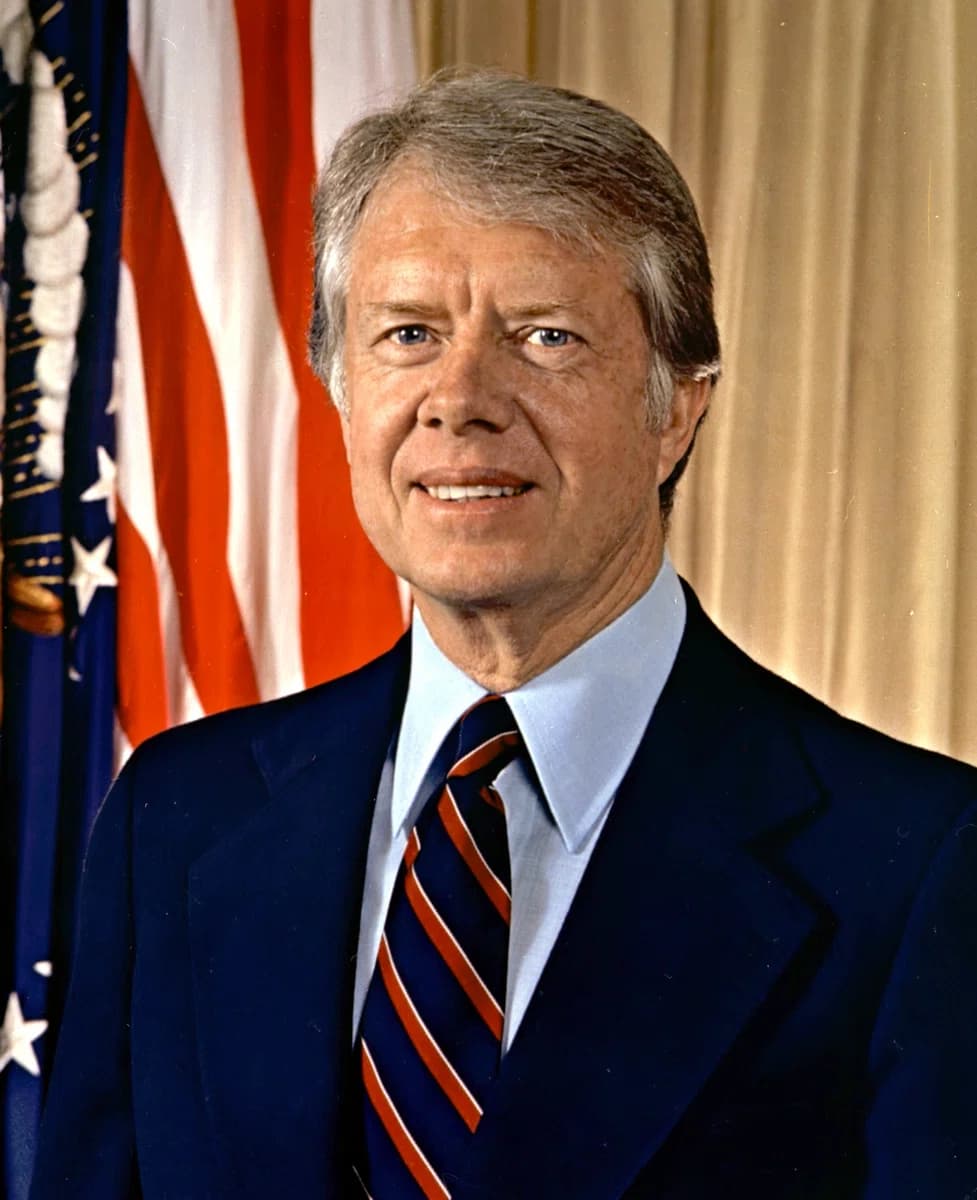
President of the United States from 1977 to 1981
0 Entries
Be the first to share a memory.
Jimmy Carter (born 1 October 1924 in Plains, Georgia; died 29 December 2024 in Plains) was the 39th president of the United States, governor of Georgia, naval officer, author and Nobel Peace Prize laureate. His presidency from 1977 to 1981 was shaped by energy crisis, inflation, human rights policy, Camp David and the Iran hostage crisis. After leaving office he became one of the most unusual figures in American politics: a former president who spent decades working as an election observer, mediator, disease fighter and public moral voice.

Carter was born in Plains and grew up in rural southwest Georgia. His father, James Earl Carter Sr., was a farmer and businessman; his mother, Lillian Gordy Carter, was a nurse. After studies in Georgia, Carter graduated from the United States Naval Academy in 1946. He served as a submarine officer and was selected for Hyman Rickover's early nuclear submarine program. In the same year he married Rosalynn Smith, who came from his hometown. When his father died in 1953, Carter left the Navy and returned with his family to Plains to run the farm and warehouse businesses.
Carter entered politics locally, including through education and community boards. In 1962 he was elected to the Georgia State Senate. His path to the governorship was not direct: he lost a first campaign in 1966 and won in 1970. At his inauguration in 1971 he declared that the time for racial discrimination was over. In a state whose politics had long been shaped by segregation, that statement marked a visible break. As governor, Carter modernized administration and budgeting and became known nationally as a representative of a changing South.
On 12 December 1974 Carter announced his candidacy for president. After Watergate, his image as an untainted outsider met a political moment in which many Americans wanted renewed trust in government and office. Carter won the Democratic nomination in 1976 and defeated incumbent president Gerald Ford. He was inaugurated on 20 January 1977. His governing style combined religiously grounded duty, close attention to detail and the aim of making human rights a central part of American foreign policy.
Carter's term brought important decisions as well as severe strains. In foreign policy he mediated at Camp David in 1978 between Egyptian president Anwar Sadat and Israeli prime minister Menachem Begin. The result was the 1979 peace treaty between Egypt and Israel, one of the most durable diplomatic achievements of his presidency. His administration also normalized U.S. relations with the People's Republic of China and negotiated SALT II with the Soviet Union. At home, energy policy, inflation, unemployment and administrative reform were central concerns. The Department of Energy and Department of Education were created, and the Alaska National Interest Lands Conservation Act protected large areas in Alaska.
The seizure of the U.S. embassy in Tehran on 4 November 1979 changed how his presidency was perceived. Fifty-two Americans were held; the crisis dominated news, diplomacy and the election year. A rescue attempt in April 1980 failed. Carter remained publicly tied to the effort to free the hostages while economic problems and political exhaustion grew. In 1980 he lost the election to Ronald Reagan. Carter's term ended on 20 January 1981; the American hostages were released on the same day.
In 1982 Jimmy and Rosalynn Carter founded The Carter Center in Atlanta in partnership with Emory University. From that work came a second public life that lasted longer than his presidency. The Center worked in conflict mediation, election observation, democracy support, human rights, mental health and the fight against preventable diseases. Its campaign against Guinea worm disease became especially visible as case numbers fell dramatically over decades. Carter traveled to conflict regions, observed elections, mediated in political disputes and, with Rosalynn, also worked with Habitat for Humanity.
In 1999 Jimmy and Rosalynn Carter received the Presidential Medal of Freedom. In 2002 Jimmy Carter was awarded the Nobel Peace Prize. The Nobel Committee honored his decades of work for peaceful conflict resolution, democracy, human rights and social development. Carter wrote numerous books on politics, faith, the Middle East, human rights, aging and his own life. He remained publicly present even when his views were disputed, including in debates about Israel and Palestine. That mixture of duty, persistence and willingness to dissent shaped his later reputation.
Jimmy Carter died at his home in Plains on 29 December 2024, surrounded by his family. He was 100 years old and the longest-lived president in United States history. His life cannot be reduced to a single term in office. Carter remains connected with Camp David, difficult crisis years in the White House and an unusually active period afterward. For many people, that post-presidential work became the core of his legacy: practical help, international responsibility and the conviction that public service does not end with office.
James Earl Carter Jr. wird in Plains, Georgia, geboren.
Carter schließt die United States Naval Academy ab und beginnt seine Laufbahn in der Marine.
Jimmy Carter heiratet Rosalynn Smith aus Plains.
Nach dem Tod seines Vaters verlässt Carter die Marine und übernimmt in Plains die Familienbetriebe.
Carter wird in den Senat des Bundesstaates Georgia gewählt.
Carter wird als 76. Gouverneur von Georgia vereidigt.
Carter gibt seine Kandidatur für das Präsidentenamt der Vereinigten Staaten bekannt.
Jimmy Carter gewinnt die US-Präsidentschaftswahl gegen Gerald Ford.
Carter wird als 39. Präsident der Vereinigten Staaten vereidigt.
Carter vermittelt in Camp David eine Grundlage für Frieden zwischen Ägypten und Israel.
Ägypten und Israel unterzeichnen in Washington den Friedensvertrag, der aus den Camp-David-Verhandlungen hervorgeht.
Die Besetzung der US-Botschaft in Teheran wird zur schwersten außenpolitischen Krise von Carters Präsidentschaft.
Carters Amtszeit endet; am selben Tag werden die amerikanischen Geiseln aus Iran freigelassen.
Jimmy und Rosalynn Carter gründen in Atlanta das Carter Center für Frieden, Menschenrechte, Demokratie und Gesundheit.
Jimmy und Rosalynn Carter erhalten die höchste zivile Auszeichnung der Vereinigten Staaten.
Jimmy Carter erhält den Friedensnobelpreis für seine jahrzehntelange Arbeit in Diplomatie, Demokratie, Menschenrechten und Entwicklung.
Jimmy Carter stirbt im Alter von 100 Jahren in seinem Haus in Plains, Georgia.
No obituary has been uploaded for this memorial page yet. If you are one of the loved ones and would like to upload one, you can register as the owner of this memorial page and add it afterward.
Plains
Jimmy Carter (née James Earl Carter Jr.). Forever remembered.