/
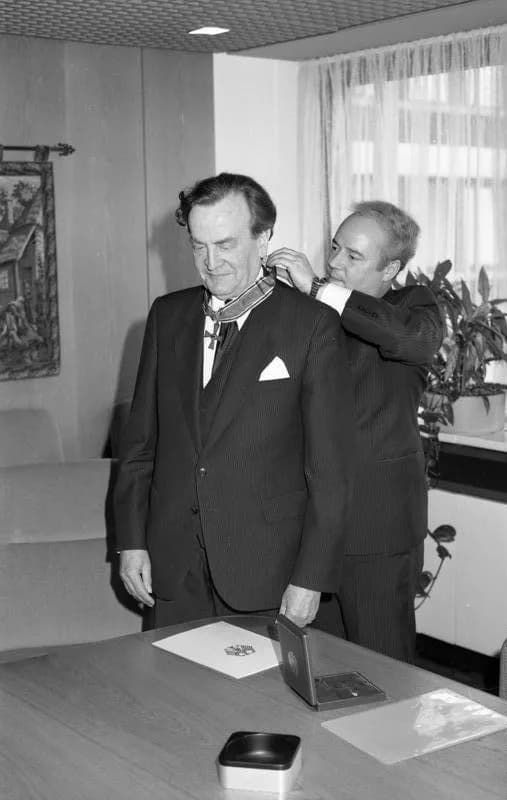
Photo: 📷 Engelbert Reineke
Biography of Philipp Freiherr von Boeselager
6. Sep 1917 – 1. May 2008(90 years)Died in:Burg Kreuzberg, Rhineland-Palatinate
German Wehrmacht officer, failed assassin of Adolf Hitler
1
Candles
0
Condolences
6
Family Tree
Biography
Birthplace
Heimerzheim Castle, Swisttal
Place of Death
Burg Kreuzberg, Rhineland-Palatinate
Awards(4)
Spouse(1)
Rosa Maria Gräfin von Westphalen zu Fürstenberg
Education(1)
Philipp Leopold Michael Hubertus Antonius Maria Freiherr von Boeselager (6 September 1917 in Heimerzheim near Bonn; died 1 May 2008 in Altenahr) was a German officer, economist, forestry association official and participant in the military resistance against National Socialism. He became known for his role around 20 July 1944, when he was involved in plans within Army Group Centre and obtained explosives for Claus Schenk Graf von Stauffenberg's assassination attempt.
Background and army career
Boeselager grew up at Burg Heimerzheim in a Westphalian noble family. After graduating from Aloisiuskolleg in Bad Godesberg, he began an officer's career in Cavalry Regiment 15 in Paderborn in 1936. He took part in the German invasion of Poland, the campaign against France and, from 1941, the war against the Soviet Union. After being seriously wounded, he became an orderly officer to Field Marshal Günther von Kluge in Army Group Centre in 1942.
Path into resistance
On the Eastern Front, Boeselager learned of German war crimes in occupied territory. In early 1943, like his brother Georg, he joined the circle around Henning von Tresckow. On 13 March 1943 he was involved in a planned attempt during Hitler's visit to Smolensk; his detachment was assigned outer security. The plan was abandoned after Kluge rejected it.
20 July 1944
For the attempted coup of 20 July 1944, Boeselager obtained explosives used in Stauffenberg's assassination attempt. His cavalry unit was also intended to provide military support for the conspirators. When the coup failed, the unit turned back. Boeselager's role remained undiscovered at first, while many participants were arrested, executed or died by suicide.
After 1945
After the war, Boeselager studied law and economics in Bonn. He managed the family estate and worked in associations of forest owners and horse breeders. From 1968 to 1998 he led the Arbeitsgemeinschaft Deutscher Waldbesitzerverbände. During the formation of the Bundeswehr, he served on the personnel review committee without becoming a career officer in the new armed forces.
Witness
From the 1970s onward, Boeselager spoke in lectures, interviews and publications about the military resistance. Historical research also places his memories within work on 20 July, since witness accounts were later shaped by conversations, other memoirs and public remembrance. Philipp Freiherr von Boeselager died on 1 May 2008 in Altenahr.
Life Events
4 Events1917
Born in Heimerzheim Castle, Swisttal
1948
Married Rosa Maria Gräfin von Westphalen zu Fürstenberg
1989
Commander's Cross of the Order of Merit of the Federal Republic of Germany
2008