/

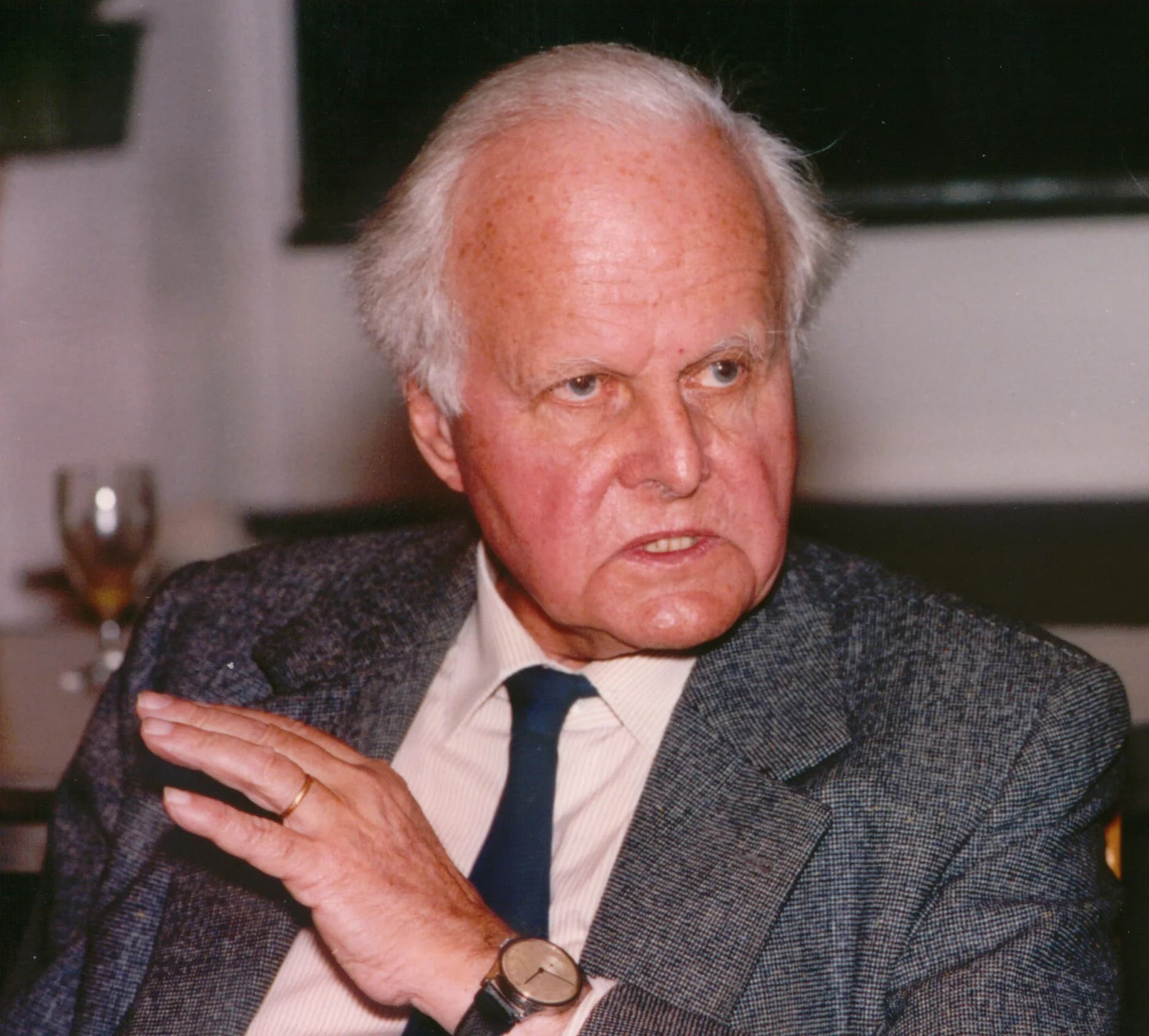
Photo: 📷 Ian Howard (of the original picture)
Biography of Carl Friedrich von Weizsäcker
28. Jun 1912 – 28. Apr 2007(94 years)Died in:Söcking, Starnberg
German physicist
2
Candles
0
Condolences
42
Family Tree
Biography
Nationality
Kingdom of Württemberg
Awards(10)
Pour le Mérite for Sciences and Arts orderGreat Cross with Star and Sash of the Order of Merit of the Federal Republic of GermanyGoethe PrizeErasmus PrizePeace Prize of the German Publishers' and Booksellers' AssociationMax Planck MedalTempleton PrizeSigmund Freud PrizeErnst Hellmut Vits AwardHonorary doctor of the Technical University of Berlin
Spouse(1)
Carl Friedrich von Weizsäcker (born 28 June 1912 in Kiel; died 28 April 2007 in Starnberg) was a German physicist, philosopher and peace researcher. His life connected theoretical physics, philosophy of science, political counsel and the question of responsibility for research in the atomic age.
Physics and early recognition
Weizsäcker came from a prominent German family; his father Ernst von Weizsäcker was a diplomat, and his younger brother Richard later became Federal President of Germany. Carl Friedrich studied physics, astronomy and mathematics in Berlin, Göttingen and Leipzig, especially in Werner Heisenberg's circle. His work on nuclear physics and on the production of energy in stars brought him international attention as early as the 1930s.
Uranium project and responsibility
During National Socialism, Weizsäcker worked in the German uranium project. This phase remains historically burdened, because German physicists carried out nuclear research under wartime conditions and questions of intention, knowledge and responsibility are still debated. Weizsäcker's later peace work does not erase that past. It belongs to the field of tension in which his public reflections on guilt, insight and scientific responsibility are read.
Postwar years and Göttingen Declaration
After the war Weizsäcker worked at the Max Planck Institute for Physics in Göttingen. In 1957 he was one of the eighteen nuclear scientists who signed the Göttingen Declaration against nuclear armament of the Bundeswehr. This step made him an important voice in West Germany's atomic debate. He spoke not only as a natural scientist, but as someone who wanted to discuss publicly the political consequences of scientific knowledge.
Philosophy and Starnberg
Weizsäcker increasingly turned toward the philosophy of science. In Hamburg he worked on the conceptual foundations of physics; later, in Starnberg, he led the Max Planck Institute for the Research of Living Conditions in the Scientific and Technical World together with Jürgen Habermas. There, nuclear war, environmental destruction, development policy and the consequences of modern technology moved to the centre. His work sought a connection between natural science, ethics and political practice.
Public impact
In 1963 Weizsäcker received the Peace Prize of the German Publishers and Booksellers Association. Other honours followed, including the Erasmus Prize, the Sigmund Freud Prize for scientific prose and the Templeton Prize. He wrote books on natural history, philosophy, religion, war and peace. His language was often demanding, but his central theme was clear: knowledge creates power, and power requires responsible limitation.
Farewell
Carl Friedrich von Weizsäcker died in Starnberg on 28 April 2007. He was 94 years old. His work as a researcher and thinker does not smooth over German postwar history, but touches precisely its most difficult questions: nuclear research, guilt, peace and the political responsibility of science.
Life Events
11 Events1912
Born in Kiel, Kreisfreie Stadt Kiel
1937
Married Gundalena Inez Eliza Ida Weizsäcker
1957
Max Planck Medal
1958
Goethe Prize
1963
Peace Prize of the German Publishers' and Booksellers' Association
1969
Erasmus Prize
1973
Great Cross with Star and Sash of the Order of Merit of the Federal Republic of Germany
1980
Ernst Hellmut Vits Award
1988
Sigmund Freud Prize
1989
Templeton Prize
2007