/

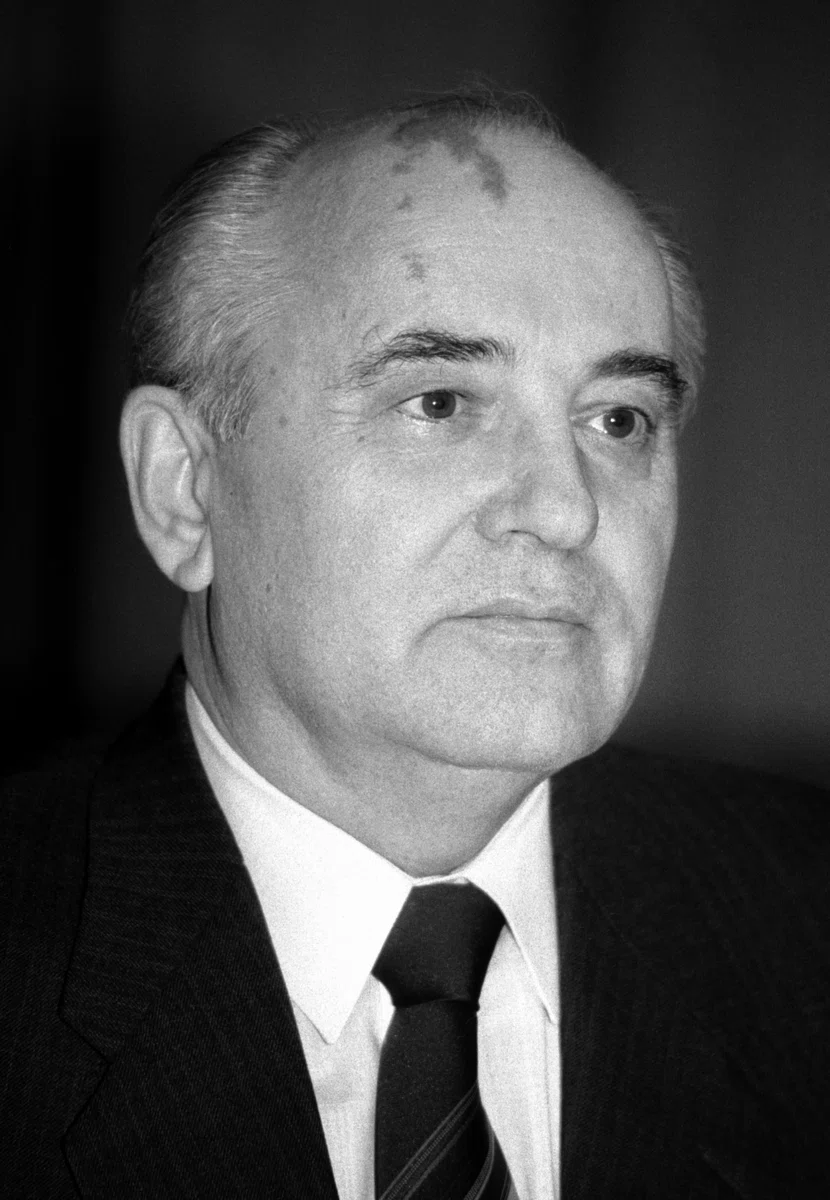
Photo: 📷 Leo Medvedev/Лев Леонидович Медведев
Biography of Michail Sergejewitsch Gorbatschow
2. Mar 1931 – 30. Aug 2022(91 years)Died in:Central Clinical Hospital, Moscow Oblast
Leader of the Soviet Union from 1985 to 1991
1
Candles
0
Condolences
5
Family Tree
Biography
Place of Death
Central Clinical Hospital, Moscow Oblast
Children
1
Burial Place
Novodevichy Cemetery
Mikhail Sergeyevich Gorbachev (born 2 March 1931 in Privolnoye, Stavropol region; died 30 August 2022 in Moscow) was a Soviet and Russian politician. From 1985 to 1991 he was General Secretary of the CPSU, and in 1990 and 1991 the first and only president of the Soviet Union. Through glasnost, perestroika, arms control and the refusal to maintain military control over Eastern Europe, he changed world politics. His name stands for the end of the Cold War, but also for the collapse of a state he had hoped to reform and preserve.
Background and education
Gorbachev was born into a peasant Russian-Ukrainian family in the south of the Russian Soviet republic. His childhood was shaped by collective farming, the violence of Stalin's era and the Second World War. As a teenager he worked with his father on a combine harvester; in 1949 he received the Order of the Red Banner of Labour for harvest work. In 1950 he began studying law at Moscow State University. There he met Raisa Titarenko, a philosophy student, who became his wife in 1953.
Stavropol and party rise
After graduation, Gorbachev returned to Stavropol in 1955. He first worked in the Komsomol and then rose through the regional party organization. In 1970 he became First Secretary of the party committee in the Stavropol region. The region was agriculturally important and also a resort area for leading officials; through it Gorbachev came to know senior figures such as Alexei Kosygin and Yuri Andropov. In 1978 he moved to Moscow, became Central Committee secretary for agriculture and in 1980 a full member of the Politburo.
General secretary and the start of reform
On 11 March 1985 Gorbachev was elected General Secretary of the CPSU. He was much younger than the Soviet leaders who had immediately preceded him and came to power with the aim of renewing a stagnant economy and a cumbersome bureaucracy. From this reform movement came the key terms perestroika, or restructuring, and glasnost, or openness. The press could report more freely, Stalinist crimes were discussed more publicly, and elections became cautiously more plural. At the same time, the process remained contradictory: the planned economy lost control without a stable new system taking its place.
Arms control and the end of the Cold War
In foreign policy Gorbachev sought détente with the West. Meetings with Ronald Reagan and later George H. W. Bush made arms control possible again. In 1987 Gorbachev and Reagan signed the INF Treaty, eliminating an entire category of intermediate-range nuclear missiles. In 1989 the Soviet withdrawal from Afghanistan was completed. In Eastern Europe, Moscow no longer intervened as it had in Hungary in 1956 or Prague in 1968 when communist regimes began to shake. That restraint opened space for the political upheaval of 1989, the fall of the Berlin Wall and German unity.
Between opening and collapse
The reforms released forces Gorbachev could no longer control. National movements grew in several Soviet republics; in others there was unrest and violence. The economic situation worsened, shortages increased and Boris Yeltsin became a powerful rival in Russia. In 1990 Gorbachev became president of the Soviet Union, while the Communist Party lost its constitutional monopoly on power. He tried to hold the Union together in altered form. For many people in Central and Eastern Europe he became a figure of liberation; for many former Soviet citizens he remained connected with uncertainty, state collapse and the loss of old securities.
1991
In August 1991 conservative forces tried to stop the reform process. Gorbachev was held in Crimea, but the coup failed in the face of resistance in Moscow, especially around Boris Yeltsin. Afterward Gorbachev's power was severely weakened. Republics declared independence and central institutions broke apart. On 25 December 1991 Gorbachev resigned as president of the Soviet Union. That evening the red flag over the Kremlin was lowered. Gorbachev had helped end the Cold War, but had not been able to prevent the disappearance of his own state.
After the Soviet Union
From 1992 Gorbachev led the Gorbachev Foundation and later also worked with Green Cross International, social democratic projects and international dialogue forums. He wrote books, gave lectures and commented on Russian politics. His wife Raisa died in 1999; she had been far more visible in his public role than earlier wives of Soviet leaders. In Russia, Gorbachev's standing remained divided. Abroad he was often honored as a statesman who avoided violence and made Europe's transition possible. At home, many remembered him through loss, disorder and the harsh decline of the 1990s.
Farewell
Mikhail Gorbachev died in Moscow on 30 August 2022. He was 91 years old. His life belongs among the major political biographies of the twentieth century because it does not permit a simple balance sheet. Gorbachev was the reformer of a system whose contradictions proved stronger than his reforms. He was a Soviet party man who opened spaces for freedom. He was not a victor in the usual sense, but a politician whose decisions released millions of people in Europe and beyond from the logic of the Cold War.
Life Events
11 Events1931
Born in Privolnoye, Stavropol Krai
1953
Married Raisa Gorbacheva
until 1999
1966
Order of the Badge of Honour
1978
Order of the October Revolution
1989
Princess of Asturias Award for International Cooperation
1990
Nobel Peace Prize
1992
honorary citizen of Berlin
1997
Commandeur des Arts et des Lettres
2001
Order of Honour
2008
Free Your Mind
2022