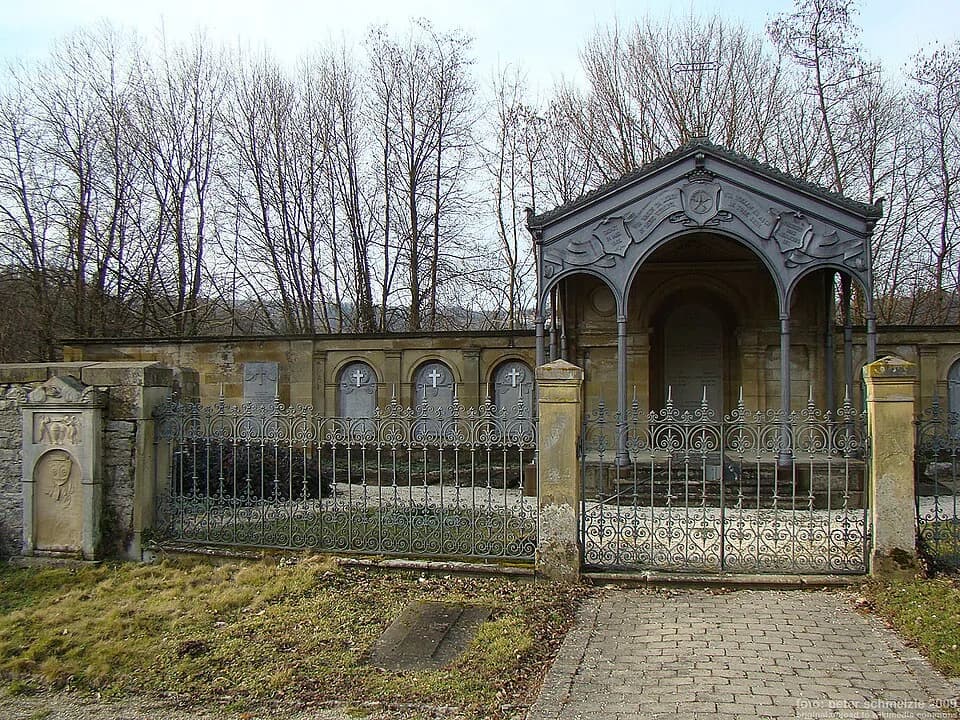
Friedhof Jagsthausen
Jagsthausen

Former President of the Federal Republic of Germany
1 candle
Emoria lights a memorial candle for Roman Herzog's birthday.
Emoria
April 5th, 2026
0 Entries
Be the first to share a memory.
Roman Herzog (born 5 April 1934 in Landshut; died 10 January 2017 in Bad Mergentheim) was a German jurist, CDU politician and Federal President from 1994 to 1999. Before his presidency he had been a scholar, state politician, judge and president of the Federal Constitutional Court. He became especially known for his Berlin speech of 26 April 1997, which entered German politics as the “Ruck” speech because of its call for a new push through Germany.
Herzog studied law in Munich, earned his doctorate and completed his habilitation. He taught constitutional law and political science, combining academic precision with a strong interest in state order, constitution and responsibility. This legal formation remained visible in his later offices. Herzog often argued in fundamental terms, not only in day-to-day political language. For him, democracy was not merely a procedure, but an order that makes demands on citizens and institutions alike.
In Baden-Württemberg Herzog took on political responsibility, including offices as minister of education and interior minister. He later moved to the Federal Constitutional Court. From 1987 he led the court as its president. This stage was decisive for his public profile: Herzog was seen as a jurist who mastered the language of law but could also explain political contexts. When he became Federal President in 1994, he brought that experience into an office shaped strongly by speech, symbols and orientation.
On 23 May 1994 Roman Herzog was elected Federal President. He was the second president of reunified Germany. His term dealt with internal cohesion after reunification, reform debates and Germany's role in Europe. Herzog also set important accents in the politics of remembrance. In 1996 he established 27 January, the anniversary of the liberation of Auschwitz concentration camp, as a day of remembrance for the victims of National Socialism.
On 26 April 1997 Herzog gave his best-known speech at Berlin's Hotel Adlon. He spoke about reform deadlock, entrenched privileges, courage for change and the responsibility of state and society. His call for a new push through Germany became a catchword. The phrase was often shortened or used in different political ways. At its core, Herzog's speech called for democratic self-examination: what has to change so that freedom, prosperity and social responsibility are not merely administered, but renewed?
After leaving office, Herzog remained present as a speaker, author and legal voice. He was active in foundations, universities and public debates. Roman Herzog died in Bad Mergentheim on 10 January 2017. His importance lies in the connection of constitutional thinking and public address: he wanted not only to represent, but to explain, offer orientation and speak to a society about its own responsibility.
Roman Herzog wird in Landshut in Bayern geboren.
Die Bundesversammlung wählt Herzog zum Bundespräsidenten der Bundesrepublik Deutschland.
Im Hotel Adlon hält Herzog seine als „Ruck-Rede“ bekannt gewordene Berliner Rede.
Roman Herzog stirbt im Alter von 82 Jahren in Bad Mergentheim.
No obituary has been uploaded for this memorial page yet. If you are one of the loved ones and would like to upload one, you can register as the owner of this memorial page and add it afterward.
Jagsthausen
Roman Herzog. Forever remembered.