
Biography of Marie Curie
7. Nov 1867 – 4. Jul 1934(66 years)Died in:Sancellemoz, Auvergne-Rhône-Alpes
Polish-French physicist and chemist
0
Candles
0
Condolences
12
Family Tree
Biography
Nationality
Second Polish Republic
Burial Place
Panthéon
Occupation(3)
Awards(10)
Spouse(1)
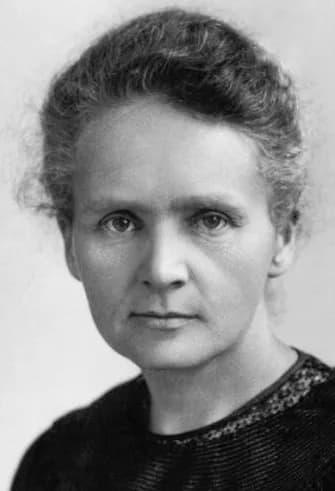
Marie Curie (born Maria Skłodowska on 7 November 1867 in Warsaw; died 4 July 1934 at the Sancellemoz sanatorium in Haute-Savoie) was a Polish-French physicist and chemist. She shaped the study of radioactivity, discovered the elements polonium and radium with Pierre Curie and Gustave Bémont, and became the first person to receive two Nobel Prizes. Her work led from a modest Paris laboratory into 20th-century medicine.
Warsaw and Paris
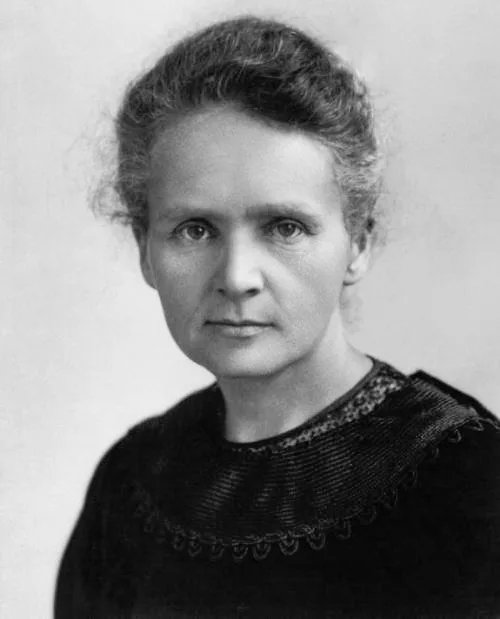
Maria Skłodowska grew up in Warsaw in a family of teachers. Poland was then under Russian rule, and women had limited access to higher education. She continued learning nevertheless, worked for a time as a governess and in 1891 followed her sister to Paris. At the Sorbonne she studied physics and mathematics under difficult financial conditions. These years already show what would define her later life: discipline, scientific precision and an almost uncompromising seriousness toward education.
Work with Pierre Curie
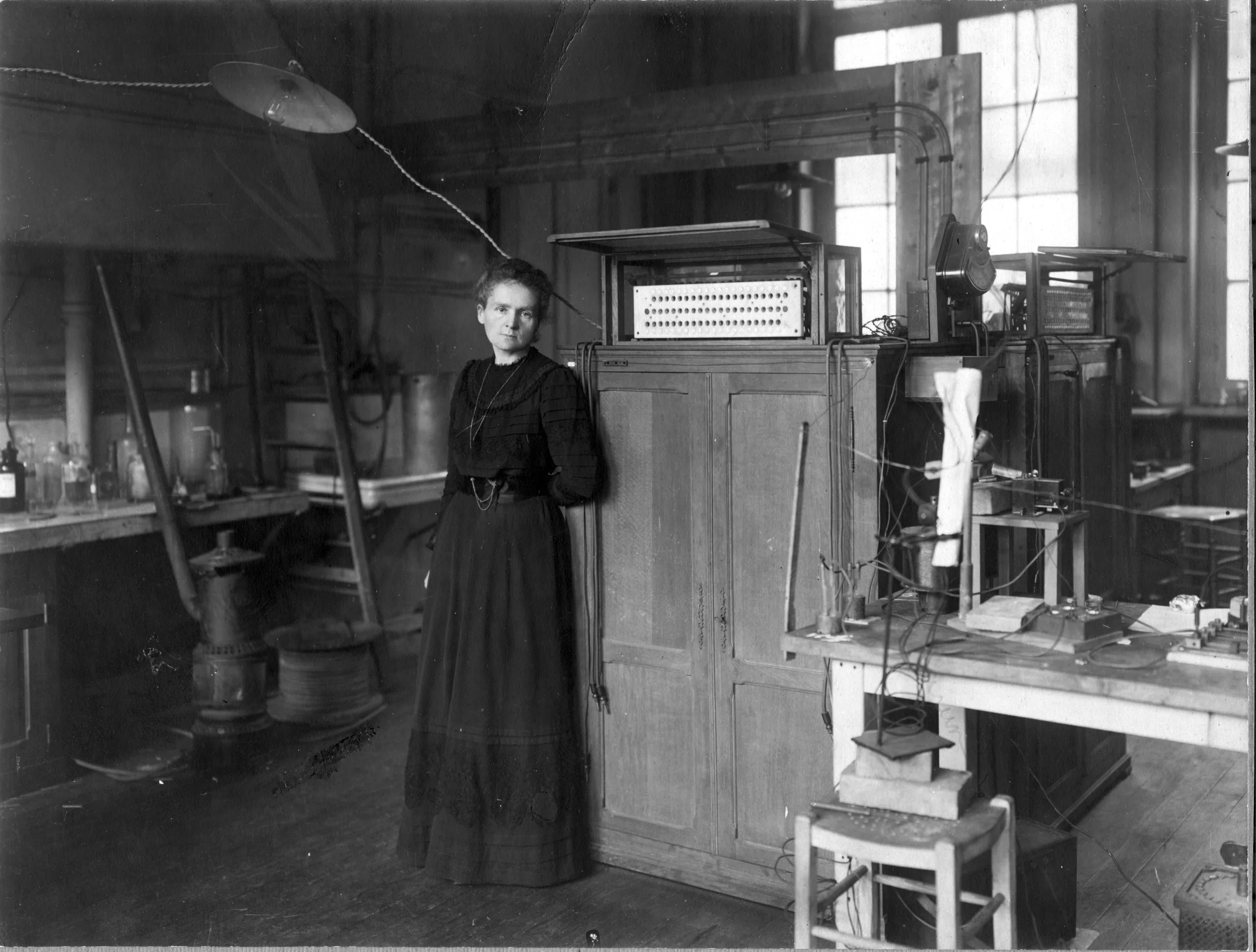
In 1894 she met Pierre Curie, a physicist with his own established research. Their marriage also became a working partnership, but Marie Curie was never a secondary figure in Pierre's laboratory. For her doctoral research she studied the rays from uranium observed by Henri Becquerel and turned them into a systematic programme of measurement. The word radioactivity became associated with this work. In 1898 the Curies announced first polonium, named for Marie's country of origin, and then radium as new elements.
Nobel Prizes and scientific authority
In 1903 Marie Curie received the Nobel Prize in Physics together with Pierre Curie and Henri Becquerel. That same year she earned her doctorate in Paris. After Pierre's accident in 1906, she continued the work and took over his chair at the Sorbonne, becoming the first woman to hold that position. In 1911 she received the Nobel Prize in Chemistry for her work on radium and polonium. Curie thereby became an exceptional scientific figure, but she remained above all a researcher: her authority rested on measurement, endurance and the ability to draw new knowledge from the smallest traces.
Medicine, war and responsibility
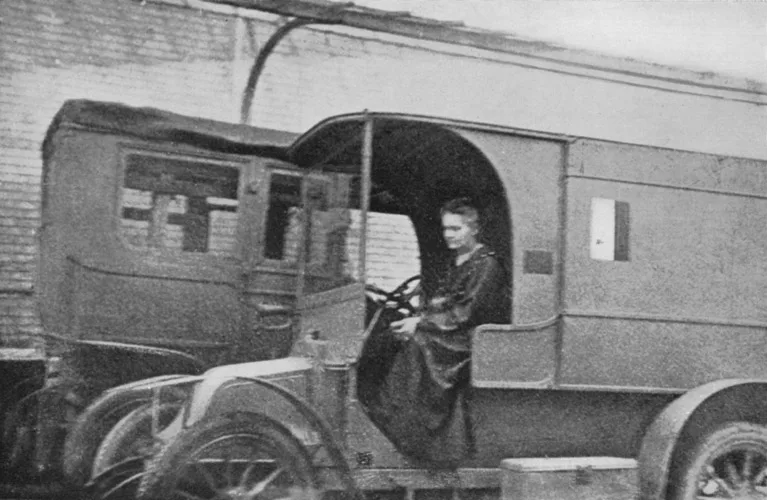
Curie understood early that radioactivity was not only a physical phenomenon, but also opened medical possibilities. This idea helped lead to the Radium Institute in Paris, where laboratory science and medicine were meant to work together. During the First World War she applied her knowledge practically: she organized mobile X-ray units that helped wounded soldiers near the front by making shrapnel and bone fractures visible. Her daughter Irène worked with her. This work was not glamorous, but concrete, technical and urgent.
Institute, international work and later years
After the war Curie remained closely connected with radium research and medical application. In 1921 she travelled to the United States, where a fundraising campaign provided one gram of radium for her work. The creation and support of laboratories in Paris and Warsaw also belonged to her life's work. Curie did not seek loud fame. She used her visibility to make research possible, train younger scientists and strengthen international cooperation.
Farewell
Marie Curie died on 4 July 1934 at the Sancellemoz sanatorium in Haute-Savoie. Contemporary and later accounts connect her illness with long exposure to radioactive substances and unshielded X-ray work, although the dangers were not yet sufficiently understood in her time. In 1995 Marie and Pierre Curie were transferred to the Pantheon in Paris. Her name stands not only for two Nobel Prizes, but for a form of science that joined precision, courage and responsibility.
Life Events
13 Events1867
Born in Warsaw, Masovian Voivodeship
1891
University of Paris
Master of Science · until 1893
1895
Married Pierre Curie
until 1906
1903
Nobel Prize in Physics
1903
Davy Medal
1904
Matteucci Medal
1907
Actonian Prize
1909
Elliott Cresson Medal
1910
Albert Medal
1911
Nobel Prize in Chemistry
1921
Willard Gibbs Award
1921
John Scott Award
1934